Uniswap Launches All Three Protocol Versions on Hyperliquid’s Elysium Network
TL;DR:
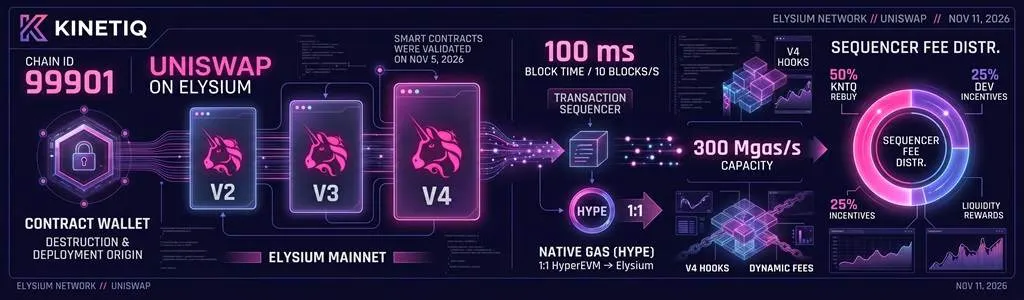
- Uniswap simultaneously deployed its v2, v3, and v4 protocols on the Elysium network, identified under Chain ID 99901.
- The network uses Hyperliquid’s HYPE token as the exclusive asset for gas fees and settles transactions on HyperEVM.
- Elysium’s infrastructure operates with target block times of 100 milliseconds and liquidity tied to Hyperliquid.
Uniswap introduced all three versions of its protocol on the Elysium network this Wednesday, enabling developers and liquidity providers to access its official contracts. The deployment was formalized on November 11, 2026, two days after the public mainnet launch developed by Kinetiq.
Uniswap v2, v3, and v4 are live on Elysium
Builders can find official deployment addresses in our developer docshttps://t.co/8fFClmhwxX
— Uniswap (@Uniswap) November 11, 2026
The exchange used its official channels to confirm that the contract addresses for v2, v3, and v4 are already documented for immediate technical integration. The move marks the first time the exchange’s entire contract stack has been ported to a Layer 2 solution closely linked to Hyperliquid.
Elysium was designed to operate with a target block time of 100 milliseconds, equivalent to a frequency of ten blocks per second. In terms of compute, the project’s technical records point to a processing capacity of approximately 300 Mgas/s.
The network’s economic framework lacks its own governance token or independent emissions. Instead, the HYPE token serves as the sole unit of payment for settling transactions.
Kinetiq reported that moving HYPE between HyperEVM and Elysium executes at a 1:1 parity ratio, functioning as native gas without the intermediation of wrapped tokens. Similarly, ERC-20 standard assets from HyperEVM can be transferred to the new network without additional permissions.
Uniswap’s documentation assigns Elysium the network identifier Chain ID 99901. Meanwhile, the HyperEVM settlement layer retains Chain ID 999 distinctly within the global protocol registry.
Technical Contract Integration and Sequencer Structure
In terms of security and verification, the smart contracts for all three versions were validated on November 5, 2026, four days prior to the network’s public opening. The deployment transactions originated from the institutional wallet that Uniswap Labs routinely utilizes for official deployments on Ethereum and Unichain.
For version v4, Uniswap Labs highlighted that the architecture features support for dynamic fee tools and customized liquidity hooks. In the technical registry, the PoolManager contract address for Elysium operates with parameters independent of those used on other compatible chains.
The network’s economic model establishes a scheduled distribution of fees generated by the sequencer. Kinetiq formalized a commitment to allocate 50% of these revenues toward KNTQ token buybacks, while 25% will be set aside directly for developer incentives.
Official documentation indicates that teams building on Elysium will be able to allocate these funds toward liquidity programs, fee rebates, or user rewards. Among the use cases outlined by promoters are spot trading, lending markets, derivatives, and the issuance of new assets.
Launchpad platforms such as Supercolony and Citadel implemented contracts to route the flow of new tokens into mandatory paired pools against HYPE. According to Kinetiq data, this design ties initial market depth directly to the available liquidity within that trading pair.
The launch on Elysium expands the catalog of networks where all three versions of the exchange coexist simultaneously. For decentralized traders, the environment mirrors the order routing and aggregation capabilities present in Ethereum versions.
The next milestone for the network will involve the phased integration of lending protocols and the activation of derivatives during the second half of November 2026.
This story was originally published by Crypto Economy. Read the original article.