Pump.fun Introduces New Fees to Stop Memecoin Sniping
TL;DR:
- Pump.fun will implement a flat percentage fee starting December 4, 2026, for trades executed in the creation block of each token.
- A Bitquery study covering 8.2 million launches between October 2025 and October 2026 detected sniper bot purchases in 28% of cases.
- 50% of the revenue generated by this charge will go toward automated buybacks and burns of PUMP, adding to the $463.5 million executed through September 2026.
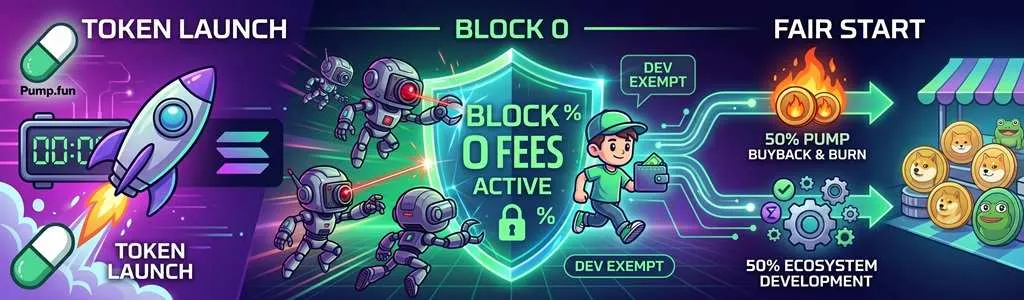
Pump.fun will introduce new fees starting next December 4. The official announcement indicates that a fixed percentage charge will apply to buys and sells executed within the same block in which a digital asset is created, technically known as Block 0.
On December 4th, we’re rolling out a block0 fee on all Pumpfun launches.
The first seconds after a coin launches decide whether it gets a fair start. Right now, block0 bundlers buy in before any other trader has a chance.
We’re introducing a block0 fee to help level the playing… pic.twitter.com/pO1m6Yez5a
— Pump.fun (@Pumpfun) November 25, 2026
The protocol used its account on X to post that the goal of this structure is to deter developers and automated traders from scooping up supplies before retail participants enter the market. Official documentation notes that the exact initial percentage rate will be disclosed ahead of the formal rollout in December.
How Pump.fun Fees Work in Block 0
The new fee structure will exempt transactions carried out directly from the primary wallet that originated the token contract. According to statements from the platform, this exemption aims to incentivize creators to keep their initial holdings visible to potential investors.
Since the deployment of its bonding curve system nearly three years ago, the protocol has allowed cryptocurrencies to be issued without upfront capital or advanced technical knowledge. However, the emergence of sophisticated trading terminals and transaction bundling services made it easier for creators to buy their own tokens via multiple secondary wallets at the moment of launch.
This practice makes it difficult for buyers to determine what percentage of the circulating supply remains under the issuer’s actual control. Platform co-founder Alon Cohen noted in a public explanation that the measure might not completely eradicate order bundling, though it will impose a direct financial cost on those using such methods.
Those who acquire assets through secondary wallets in blocks subsequent to creation will not bear this specific surcharge. According to Cohen‘s analysis, such participants will have to compete on an equal footing in terms of timing with all other market traders to secure their entry positions.
Impact of Sniping and Protocol Revenue Distribution
The scale of automated trading across the ecosystem was documented by blockchain analytics provider Bitquery in research published in October 2026. The report examined roughly 8.2 million launches recorded on Pump.fun between October 30, 2025, and October 7, 2026, finding purchases made by addresses other than the creator’s during the first block in 38% of cases.
Bitquery researchers identified patterns consistent with developer-linked wallets in 21% of issuances and sniper bot activity in 28%. Furthermore, the firm estimated that creators and their bundled addresses generated at least $579 million in net profits after fees through the end of June 2026.
In contrast to those early profits, a separate report by the same analytics firm conducted in October 2026 revealed that 79% of nearly nine million tokens created on the platform recorded no trading activity beyond their debut day. From Pump.fun‘s perspective, weaker market conditions pushed traders toward higher-risk strategies in the initial block.
Under the proposed distribution model for these fees, 50% of the collected funds will finance automated purchases and permanent burns of the native PUMP token. The remaining half will support technical development of the launchpad, its mobile app, and its trading terminal, alongside community incentives such as trading competitions and the Callout Rewards program.
This allocation complements the project’s existing buyback scheme, which through September 25, 2026, had allocated approximately $463.5 million to remove and burn 167.91 billion units of PUMP, equivalent to 16.79% of its original supply. Unlike the mechanism known as Boost Mode, the protocol will not redirect these fees back to the individual tokens that generated them, preventing early buyers from recovering part of their operating costs.
The change adds to previous adjustments to creator incentives, including a March 2026 update that limited issuance fee changes to a single occasion post-launch. The protocol team is evaluating extending this fee schedule to subsequent blocks, though it acknowledges the technical difficulty of distinguishing developer wallets from independent buyers once public trading begins.
The platform projects that the initial impact on trader behavior will be moderate, as the opening fee will be set at a low level. Trading data collected following the December 4, 2026 rollout and user feedback will determine future adjustments to the cost structure.
This story was originally published by Crypto Economy. Read the original article.