Binance Founder Warns 1Password Users to Change Their Passwords
TL;DR:
- On November 26, Changpeng Zhao recommended on the social network X changing all passwords stored in 1Password.
- The password manager launched an investigation on November 19 after detecting unauthorized access to an employee’s corporate GitHub account.
- 1Password reported on November 25 that the verification code sent via email was expanded from six digits to ten characters.
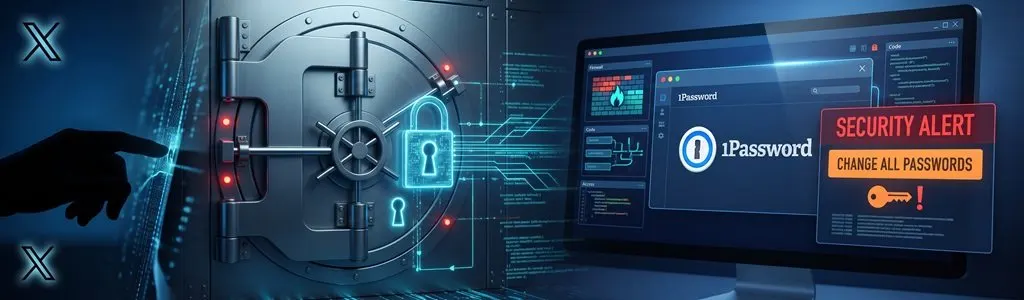
Binance founder Changpeng Zhao urged users of the password manager 1Password to change all their credentials following news of a breach in the platform’s internal systems. Through a post on X, Changpeng Zhao warns users about the need to renew their passwords even though the company assured that customer vaults were not compromised.
If you use 1Password, recommend you to change ALL your passwords. It's a pain in the neck, but necessary. https://t.co/p5XpheMwVv
— CZ 🔶 BNB (@cz_binance) November 26, 2026
The recommendation came in response to a post by Coin Bureau about the security incident disclosed by the credential management service. In his original message, Zhao noted that changing all passwords is a hassle, but necessary. Subsequently, a community note added beneath his post specified that this suggestion is not backed by the statement issued by 1Password.
Following that clarification, the executive indicated that he accepted the technical explanations provided by the company. However, Zhao argued that accounts protected with weak passwords could remain vulnerable to brute-force attacks, suggesting that the company identify and notify profiles using low-complexity passwords.
Details of the Breach in 1Password’s Internal Systems
In a statement published on November 25, 1Password explained that the internal investigation began on November 19 upon detecting signs that an attacker had accessed the corporate GitHub account of one of its employees. According to 1Password‘s official report, the intruder used that access to reach the source code and inject malicious code into backend services, enabling the download of administrative data from a subset of customers.
The extracted information included names, email addresses, account identifiers, creation dates, and last login records. According to 1Password documentation, public keys and parameters of the Secure Remote Password (SRP) protocol were also obtained—elements the company maintains do not allow entry into an account on their own.
The hacker also copied tokens included in certain invitation and recovery links sent via email, in addition to source code from private repositories. Furthermore, the incident reached the firm’s continuous integration and continuous delivery (CI/CD) system, infrastructure that stores internal operational secrets.
According to 1Password‘s official statements, encrypted vaults, the items stored inside them, and the cryptographic keys protecting them remained intact. The company stated that users do not need to update any information within their accounts and confirmed the deactivation of the compromised GitHub profile, the revocation of the stolen token, and the rotation of all exposed internal credentials.
Security Measures and Industry Alert Background
Regarding the compromised invitation and recovery tokens, 1Password indicated that they only work in conjunction with single sign-on (SSO) or a verification code sent to the account holder’s email. As an additional preventive measure, the company expanded the length of that code from six digits to ten characters and directly notified the small group of users who had pending processes at the time of the incident.
To prevent fraud stemming from the administrative data leak, 1Password asked its community to remain alert to potential phishing attempts via emails, text messages, or unexpected calls. The firm reminded users that it never asks for an account password or the Secret Key, which is only required when logging in for the first time on a new device or browser.
Cybersecurity warnings have been a recurring theme in Zhao‘s recent public remarks. Following an attack recorded on October 29 in which hackers stole nearly $6.36 billion from Binance—an event after which the platform allocated $6.34 million of its own funds to cover losses—the exchange founder argued that the industry should use artificial intelligence to curb attacks powered by that same technology and anticipated that more incidents could occur in the near term.
Days earlier, on October 23, Zhao had dismissed fears about artificial intelligence’s ability to breach cryptographic networks, pointing out that traditional banking and internet infrastructure rely on weaker encryption standards. In line with his current stance, the executive has previously reiterated the advisability of avoiding links in emails and adopting physical security keys, such as YubiKey, to block spoofing attacks.
Currently, 1Password continues reviewing its technical response alongside external cybersecurity experts hired following the November 19 incident, while users notified regarding pending invitations or recoveries complete those processes under the new ten-character verification scheme.
This story was originally published by Crypto Economy. Read the original article.