OFAC Sanctions Eight Canadian Money Services Firms That Swapped Rials for Crypto

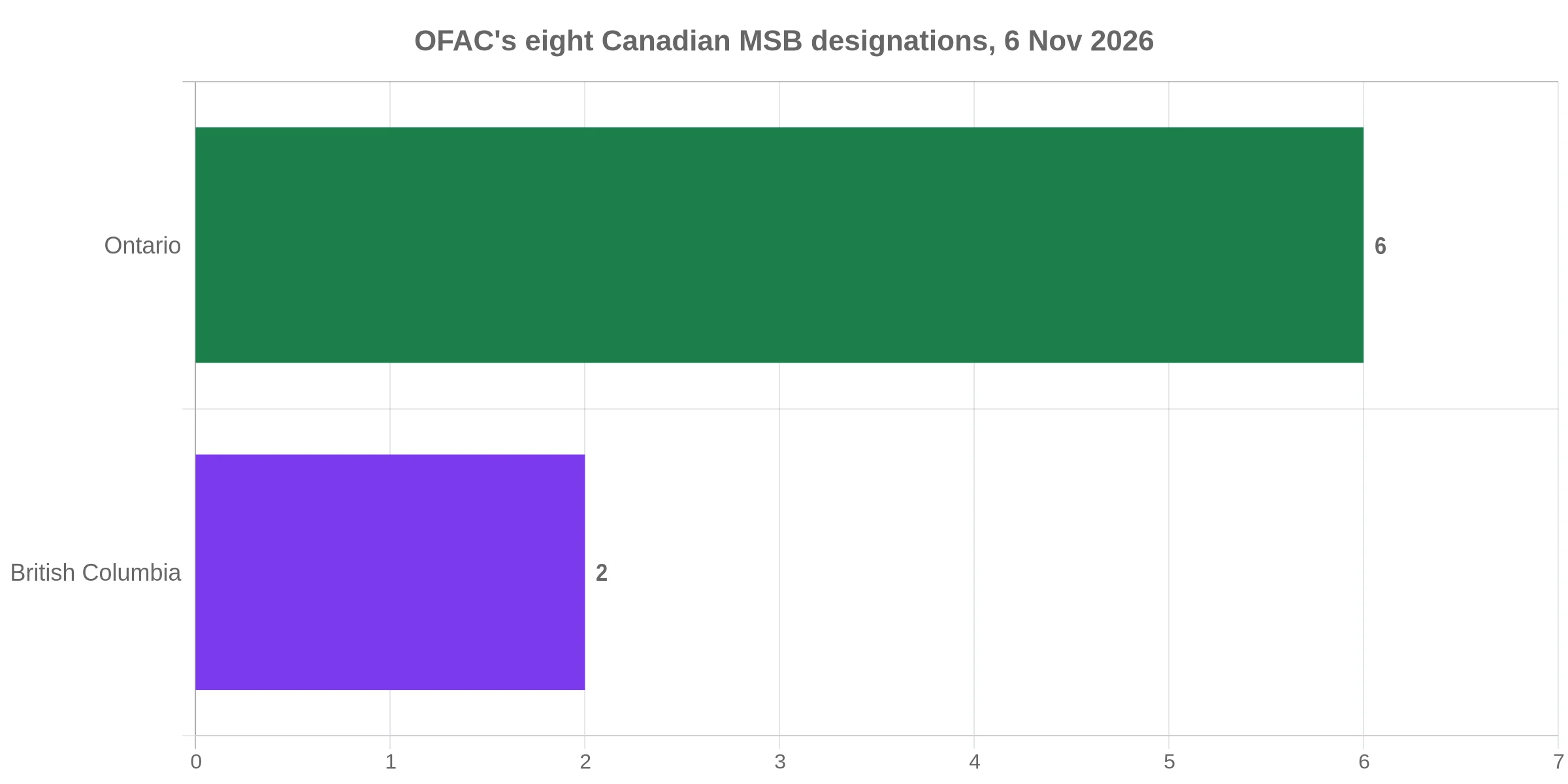
Eight Canadian money services businesses lost their footing in the U.S. financial system on Nov. 6, when the Treasury Department’s Office of Foreign Assets Control designated them for converting Iranian rials into digital assets for the Islamic Revolutionary Guard Corps, sanctioned Iranian exchanges and drug trafficking networks. Six of the eight are Ontario companies. Two are based in British Columbia. All eight are blocked under Executive Order 13902, the authority Treasury uses against the Iranian digital asset sector.
The designations are the Canadian leg of Operation Economic Outcast, the campaign Treasury opened in August to cut the financial channels that keep Iran’s digital asset economy running. In the same notice, Treasury describes a rail that is easy to describe and hard to police: cash or rial deposits at a storefront exchange, converted into bitcoin or tether, then sent to an address abroad that no Canadian bank ever sees.
Treasury Secretary Scott Bessent framed the action as a warning to the host country rather than to the eight firms alone. “Canada cannot be a safe haven for illicit financial facilitators that provide sanctions evasion services to the Iranian regime and its proxies,” he said. “Treasury will pursue and disrupt the Iranian regime’s financial channels anywhere in the world.”
What Treasury says each of the eight did
The release does not treat the eight as interchangeable. It names each one and attaches a specific pattern of flows, which matters for anyone trying to judge whether this is a rounding error or a structural channel.
Million Exchange, the trading name of Ontario-based Diverse Trade Inc, advertises rial exchange and digital asset management. Treasury says addresses tied to the firm sent the equivalent of hundreds of thousands of dollars to addresses associated with the IRGC or other terrorism-related addresses, and that it laundered drug proceeds by buying digital assets with cash from drug sales and sending them back to dealers.
Amin Exchange appears twice. British Columbia-based 1380079 BC Limited does business under the name, and Ontario-based Top PC Technician Inc, described as a closely associated affiliate, uses the same brand. Treasury says addresses linked to Amin Exchange received hundreds of thousands of dollars from Shelbit, the Iranian exchange Treasury sanctioned on Aug. 7 for moving millions on behalf of the IRGC, and laundered millions of dollars in drug proceeds at locations in Toronto, Vancouver and Montreal.
NIA Nations Currency Ltd, also in British Columbia, advertises digital asset exchange and transfers from Iran to Canada. Its addresses transacted with IRGC-linked addresses and with Nobitex, Wallex, Ramzinex and Bitpin, the four Iranian exchanges Treasury designated on June 2, 2026.
Farah Exchange, the trading name of 2397639 Ontario Ltd, describes itself as an Iranian exchange operating in Canada. Treasury says one of its addresses conducted hundreds of thousands of dollars of business with Shelbit and Wallex, sent thousands of dollars to terrorism-associated addresses, and sent millions of dollars to addresses associated with Wedding.
CCC Inc and B Galaxy Inc operate from the same Ontario location. CCC Inc’s website offers digital currency trading and states that it is licensed in both Iran and Canada, and Treasury says one of its addresses received hundreds of thousands of dollars from terrorism-associated addresses. B Galaxy, which trades as Cryptoyal, advertises unlimited digital assets in exchange for Iranian currency.
Darvish Exchange, the last of the eight, advertises bitcoin-for-rial exchange. One of its addresses transacted with Nobitex, Wallex, Aban Tether Exchange and Shelbit, which is four of the six Iranian exchanges Treasury has designated this year.
Six of eight sit in Ontario, and four carry IRGC or terrorism links
Read as a dataset rather than a list of allegations, the release describes a channel concentrated in two provinces and heavily weighted toward the Toronto area. Six of the eight companies are Ontario entities (75%), two are British Columbia entities (25%). Four of the eight (50%) have digital asset addresses that Treasury ties directly to IRGC or terrorism-associated addresses: Million Exchange, NIA Nations, Farah Exchange and CCC Inc.
Three of the eight (37.5%) are named in the section on Wedding, the OFAC-designated Canadian drug trafficker apprehended in January 2026: Million Exchange, Amin Exchange and Farah Exchange. Treasury says Wedding used money exchange businesses in the Vancouver and Toronto areas to launder billions of dollars in drug proceeds, with couriers carrying bulk cash to the firms, which converted it to digital assets for transfer abroad.
That overlap is the part of the release with the longest tail. A sanctions case built on terrorism financing is a foreign policy argument. A sanctions case that also describes cash couriers handing drug money to storefront exchanges in two Canadian cities is a domestic law enforcement argument, and it is being made with the Drug Enforcement Administration named as a coordinating agency.
The rail Treasury is describing
Canada’s role here is not mining, not trading, and not custody. It is the cash-to-crypto conversion step that sits between Iranian rial and a blockchain, and Treasury’s own description of the country’s market explains why the step exists.
“Canada is home to hundreds of money services businesses that enable the movement of funds into and out of Iran, both through cash-based value transfer systems and by converting cash into digital assets to send across borders,” the release states. It adds that the designated entities “remain operational” and that “several of these entities have changed their business names and addresses in an attempt to evade detection and enforcement actions.”
That last sentence is an admission about enforcement mechanics. A designation that follows rebranding is chasing a moving target, and Treasury is signalling that the compliance burden now falls on counterparties: banks, payment processors and exchanges that touch these firms or their addresses inherit the exposure.
The same day, FinCEN cut MEXC off from dollar clearing
The Canadian action did not arrive alone. On Nov. 6, FinCEN issued an order effectively cutting MEXC Global off from the U.S. financial system, describing it as a convertible virtual currency exchanger that had facilitated at least $16 billion in illicit transactions tied to Iranian, North Korean and Russian sanctions evasion and to cybercrime, as detailed in Treasury’s MEXC release and covered here in the FinCEN MEXC order.
Bessent’s language in that action was blunter than in the Canadian one. “Financial institutions cannot have it both ways: Either you support the Iranian regime, or you have access to the U.S. financial system,” he said.
Placed side by side, the two actions describe the same pipeline from opposite ends. MEXC is the offshore venue where, according to FinCEN, sanctioned actors could convert and move value at scale. The eight Canadian firms are the on-ramp where cash and rial enter the pipeline. Treasury is now working both ends in the same week, which is a different posture from the June and August rounds that picked off individual Iranian exchanges.
What the designation changes, and what it leaves open
Legally, the effect is narrow and the reach is wide. All property and interests in property of the eight that are in the United States or held by U.S. persons are blocked and must be reported to OFAC. Entities owned 50% or more, directly or indirectly, by a blocked person are blocked as well. U.S. persons are barred from dealing with them, and non-U.S. persons are barred from causing or conspiring to cause U.S. persons to violate the sanctions, or from conduct that evades them. OFAC can impose civil penalties on a strict liability basis.
What the release does not do is equally worth recording. It announces no criminal charges against any of the eight, no asset seizures outside the standard blocking language, and no licence revocations by Canadian regulators. The designations were coordinated with FinCEN and with FINTRAC, Canada’s financial intelligence unit, but the release does not say what, if anything, FINTRAC will do with its own registrants. Nor does it put a figure on the total value that flowed through the eight firms; the amounts are described as hundreds of thousands and millions, without an aggregate.
The enforcement tail is where the numbers usually appear. FinCEN’s whistleblower incentive programme pays awards when information leads to an enforcement action with penalties above $1,000,000, and an action that names eight firms, four sanctioned Iranian exchanges and a drug network gives potential informants a lot of surface to work with.
Why the Canada pattern matters beyond these eight firms
Treasury has spent the past five weeks treating Iranian sanctions evasion as a payments plumbing problem rather than a banking one. The A7 shadow banking network designation in early October tied a Russian-built network used by Iran to a ruble-backed token that moves value on-chain, and the MEXC order this week applied the same logic to an exchange holding roughly $5 billion in reserves.
For exchange compliance teams, the practical effect is a longer counterparty list. A Canadian MSB registration is not a clean bill of health under U.S. sanctions, and the eight firms in this action show why: several were operating openly, advertising rial exchange and bitcoin conversion, and one stated on its own website that it was licensed in both Iran and Canada. Screening has to run on the digital asset addresses Treasury publishes, not only on corporate names that change.
The open question is whether FINTRAC follows with its own action. Canada’s regime and the U.S. regime are separate, and a U.S. designation does not automatically suspend a Canadian registration. Until that gap closes, the eight firms are cut off from dollar clearing while remaining legal entities in the country where they operate, which is the same asymmetry Treasury has been trying to remove all year.
Frequently Asked Questions
What did OFAC designate on November 6, 2026?
OFAC designated eight money services businesses based in Canada under Executive Order 13902: Million Exchange (Diverse Trade Inc), 1380079 BC Limited (Amin Exchange), Top PC Technician Inc (Amin Exchange), NIA Nations Currency Ltd, Farah Exchange (2397639 Ontario Ltd), CCC Inc, B Galaxy Inc (Cryptoyal) and Darvish Exchange. Six are Ontario companies and two are British Columbia companies.
Why are Canadian money services businesses relevant to Iran sanctions?
Treasury says Canada hosts hundreds of money services businesses that move funds into and out of Iran, both through cash-based value transfer and by converting cash into digital assets sent across borders. The designated firms allowed sanctioned Iranian entities to use their services, and several had digital asset addresses that transacted with IRGC-linked addresses or with Iranian exchanges Treasury had already sanctioned.
Does the designation shut these businesses down?
No. The designation blocks their property and interests in property in the United States or held by U.S. persons, and bars U.S. persons from dealing with them. Treasury’s release states that the entities remain operational in Canada; it announces no criminal charges and no Canadian licence revocations.
What is Operation Economic Outcast?
It is the Treasury campaign launched in August 2026 to cut the financial channels sustaining the Iranian regime and the IRGC, with a focus on cryptocurrency. Earlier phases designated Iranian exchanges including Nobitex, Wallex, Bitpin, Ramzinex, Aban Tether Exchange and Shelbit, and on Nov. 6 FinCEN separately cut MEXC Global off from the U.S. financial system.
This story was originally published by Blockchain Reporter. Read the original article.