Tether’s 0.8B On-Device Agent Beats a Model 2.5x Its Size on Tool Use
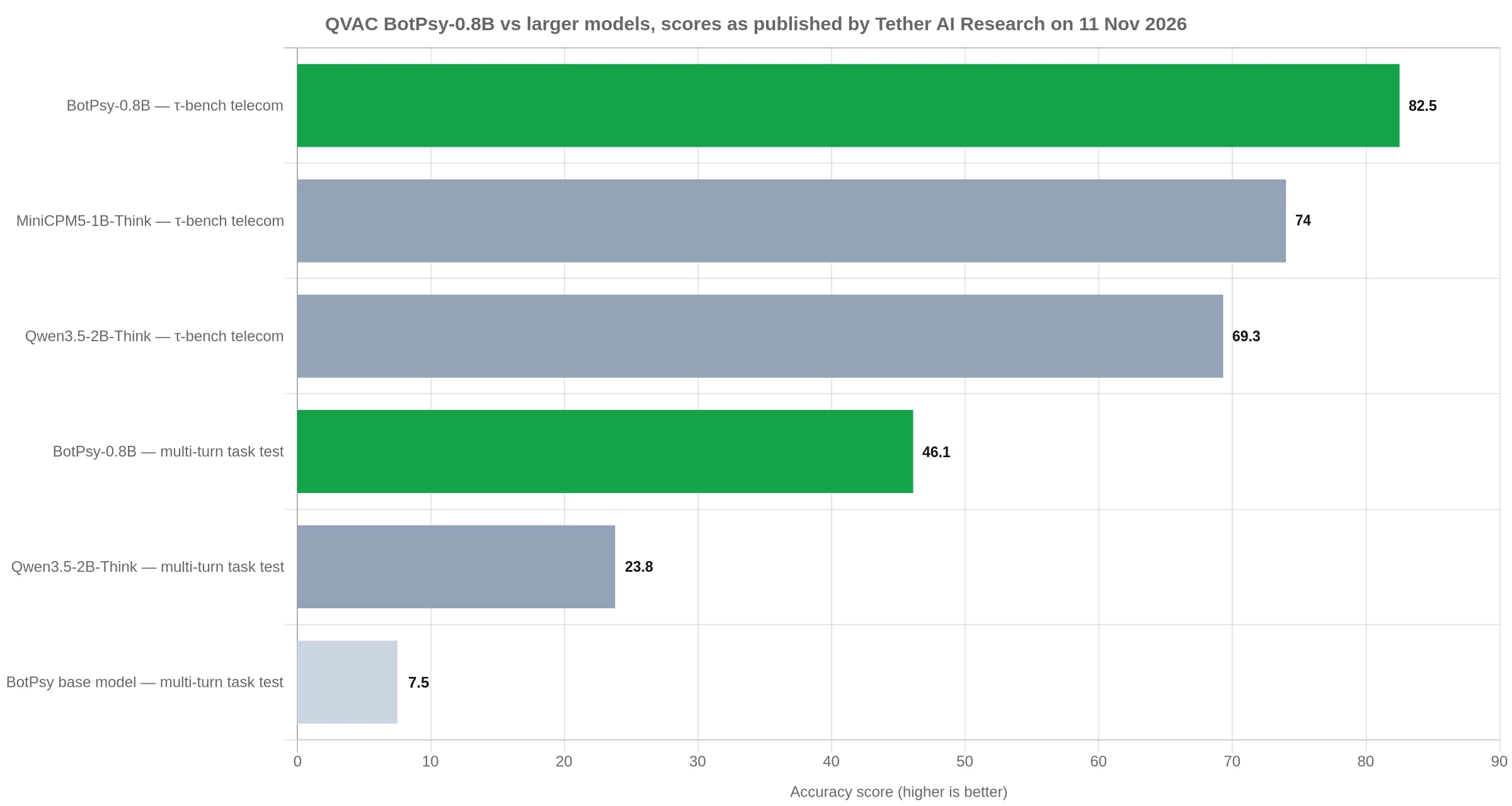
Tether’s AI research unit put a number on its claim that small models can do real work on a phone. On 11 November 2026, Tether AI Research published QVAC BotPsy-0.8B, an open-weight model with 800 million parameters built to read a request and turn it into tool calls on the device in front of the user. On a multi-turn test of continuing a task as new information arrives, Tether reports 46.1 for BotPsy against 23.8 for Alibaba’s Qwen3.5-2B-Think, a model 2.5 times larger, and 7.5 for the base model BotPsy was trained from.
That last figure is the one worth sitting with. The lift from 7.5 to 46.1 is a factor of 6.1, produced by fine-tuning an existing open architecture rather than by scaling it up. BotPsy is built on Alibaba’s open-source Qwen3.5, and Tether’s release frames the result as evidence that specialization beats size for narrow agent work: picking the right function, filling its arguments, and knowing when no function fits.
What Tether actually published
The release names six benchmarks: BFCL v4, ACEBench, τ-bench, Claw-Eval, BrowseComp-Plus and ToolSandbox. All six measure tool use, the step between a model understanding a request and an application doing something about it. Tether says BotPsy “beats every other model tested at 1.2B parameters or fewer” across those six evaluations.
The weights, evaluation documentation and quantized GGUF builds are published through the QVAC organisation on Hugging Face, at qvac/BotPsy-0.8B and qvac/BotPsy-0.8B-GGUFs. The GGUF files matter more than they look: that format is what lets a model run inside llama.cpp-class runtimes on ordinary laptops and phones, rather than in a data centre. The release also notes that references to Tether AI Research mean Tether Data, S.A. de C.V., the entity behind the QVAC initiative.
The numbers, and what they do not cover
Two comparisons carry the release. On τ-bench telecom, where an agent walks a user through a troubleshooting task over several turns, BotPsy scores 82.5 against 69.3 for Qwen3.5-2B-Think and 74.0 for MiniCPM5-1B-Think, an 8.5-point gap over the closest 1B-class model. On BFCL v4’s hallucination tests, which check whether a model declines to call a tool when no suitable tool exists, BotPsy scores 86.1, the highest among the models Tether tested.
Parameter efficiency is where the report is most striking, and where an independent reader should apply the most pressure. BotPsy’s 46.1 on the multi-turn test works out to 57.6 score points per billion parameters. Qwen3.5-2B-Think’s 23.8 works out to 11.9 points per billion, a ratio of 4.8 to 1 in BotPsy’s favour. That is a large enough gap to be interesting, and it is also entirely a comparison of models chosen by the company making the claim.
The release does not cite third-party replication, does not report latency or memory use on a named handset, and does not publish scores for the quantized GGUF builds that most people would actually run on a phone. A model can hold accuracy at 16-bit and lose several points once compressed to four-bit weights, and this release leaves that question open. It also does not say under which licence the weights are offered beyond pointing at the repositories.
Why a stablecoin issuer wants the model on your phone
Tether is not a software company that stumbled into AI. It is the issuer of the largest dollar stablecoin, with USDT at a market capitalisation of about $175.7 billion on 12 November, roughly 2.5 times USDC’s $69.6 billion, according to CoinGecko data taken at 05:15 UTC. Its AI work sits inside Tether Data, and QVAC is described in the release as an initiative whose mission is “Local AI and Infinite Intelligence”.
The argument for local inference is a data argument first. A personal assistant that books travel or reschedules meetings needs access to email, calendars and contacts, and today that usually means shipping those records to servers operated by a handful of companies. Running the model on the device keeps the records where they already are. Paolo Ardoino, Tether’s chief executive, put the case in the release:
“An assistant that manages your calendar, messages and documents needs access to some of your most personal information. Running AI locally can reduce the need to send that information to centralized providers, giving people greater control over how it is processed.”
He went further on control: “Users should decide what their assistant can access and which external services it can connect to, and developers should have the freedom to run and adapt models without depending on a single company’s servers or continued permission.”
The release sketches how that spreads across hardware. A phone acts as the always-on companion; a home computer or trusted peer-to-peer node takes on heavier requests such as document analysis or complex scheduling and sends results back. Web searches, in that design, would route through encrypted peer connections instead of a corporate cloud.
The pieces Tether has already shipped
BotPsy is the latest in a line of releases. In May 2026 the company published edge-based medical models under the same QVAC banner, aimed at running clinical language tasks on phones and wearables. In July it shipped QVAC SDK 0.15.0, adding prompt batching and GPU support to the developer kit that these models plug into. Both releases share the same pitch: capability that fits inside a device, released as weights rather than as an API.
The pattern connects to the company’s other businesses in ways the release does not spell out. Tether has spent 2026 moving into mining infrastructure and energy through its MDK programme, where AI workloads and Bitcoin data centres are being discussed as the same physical footprint. A model small enough to run on a phone and a data centre built to host compute are two ends of one strategy: own the layer where inference happens rather than renting it.
Compare that with how the largest AI labs are shipping agents. Their tool-use capability arrives through hosted endpoints, priced per token, with the model and its weights staying inside the provider. Tether’s version puts a 1.6-gigabyte weight file, at 16-bit precision by simple arithmetic on the parameter count, into a format anyone can download and run offline. That is a different distribution model, and it is the part with real consequences for developers who cannot or will not depend on a single vendor’s servers.
What the release leaves open
Three questions decide whether BotPsy matters beyond a launch post. The first is reproduction: whether researchers outside Tether can match 46.1 and 82.5 with the published weights and the published evaluation code, or whether the gap narrows once someone else runs the tests. The second is device performance, since a model that fits in memory is not the same as a model that answers fast enough to be useful on a mid-range phone. The third is product: whether QVAC ships an assistant that ordinary users can install, or whether BotPsy remains a research artifact that developers fork.
The benchmark framing also has a boundary. Tool-use scores measure whether a model picks the right function and fills its arguments correctly. They say little about reasoning over long documents, and nothing about how the model behaves when the tools themselves are wrong. An assistant that reliably declines to invent a tool call, which is what the BFCL hallucination result tests, is useful; an assistant that reliably completes a booking with the wrong date is not, and that failure mode sits outside these six evaluations.
What is documented is narrower and more concrete than the headline. An 800-million-parameter model, fine-tuned from an open Qwen3.5 base, published with weights and GGUF builds, scoring 46.1 where its base model scored 7.5 and where a model 2.5 times its size scored 23.8, in tests run by the company that built it. Whether that becomes the pattern for personal AI, or stays a well-benchmarked side project from a stablecoin issuer, will be settled by the downloads and the replications rather than by the announcement.
This story was originally published by Blockchain Reporter. Read the original article.