Solana’s RWA Market Surpasses $5 Billion as Tokenized Assets Surge 18% in a Month
TL;DR:
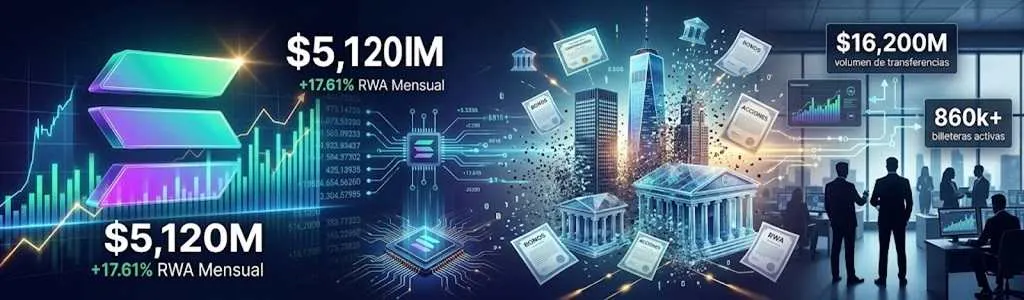
- The distributed value of real-world assets (RWA) on the Solana network reached $5.12 billion, with an all-time high of $5.19 billion reported on October 29, 2026.
- The monthly transfer volume of these instruments surged by 80.11%, hitting a total of $16.2 billion over the past 30 days.
- A total of 7 out of the 29 global systemically important banks (G-SIBs) are developing infrastructure or issuing products on Solana.
The Solana RWA market surpassed the $5 billion mark after experiencing a monthly increase close to 18% in tokenized assets, driven by the influx of traditional institutional capital.
At the close of October, the high-speed network recorded a distributed value of $5.12 billion in real-world assets, according to metrics provided by the analytics platform RWA.xyz. This figure reflects a 17.61% increase compared to data recorded 30 days earlier. Meanwhile, on October 29, the network’s official account on X reported a specific all-time high of $5.19 billion, supported by measurements from the same source.
This asset segment encompasses traditional financial securities—such as U.S. Treasury bonds, corporate equities, and investment fund shares—converted into digital representations on blockchain networks.
Growth is not limited solely to the balance sheet valuation of these instruments. Analytical data shows that 860,511 active wallets currently hold tokens classified as RWA within the protocol, representing a 14.22% increase over the last month. In total, the network hosts 3,516 distinct tokenized assets.
In parallel, capital turnover experienced a notable acceleration. The cumulative volume of RWA transfers on Solana reached $16.2 billion in the last 30 days. This amount represents an 80.11% increase compared to the previous period, excluding minting and burning transactions to strictly reflect the effective circulation of liquidity.
Nick Ducoff, Head of Institutional at the Solana Foundation, stated that crossing the $5 billion threshold is an indicator of tokenization advancing at a structural scale. According to Ducoff’s projections, financial markets will witness a gradual migration of stocks, bonds, collective investment vehicles, and cash toward decentralized infrastructure over the coming decade.
Institutional Banking Adoption and Market Backing
The ecosystem’s traction is largely due to deployments executed by major traditional financial institutions. Seven of the 29 banks classified as global systemically important banks (G-SIBs) maintain ongoing projects or integrations on the network, according to information confirmed by the Solana Foundation. These conglomerates operate under international regulatory standards, as their size and interconnectedness play a critical role in global economic stability.
Additionally, investment vehicles tied to corporations such as BlackRock and JPMorgan are among the assets deployed within the network’s architecture.
The Solana Foundation executive emphasized that the entry of these multinational institutions shifts technical adoption from a merely experimental phase to a long-term financial infrastructure standard. Ducoff added that the organization expects additional banking institutions to join before the end of 2026.
Global liquidity is further complemented by stablecoins. According to the RWA.xyz dashboard, assets pegged to fiat currencies such as the U.S. dollar represent an additional $14.32 billion in value on Solana. This segment is distributed across 13.70 million wallets, marking a 5.47% increase compared to figures from 30 days prior.
On-chain technical analysts point out that RWA figures track the economic value assigned to the base of distributed assets, which fluctuates based on primary issuances, periodic redemptions, and the valuation of the underlying market. Similarly, the monthly volume reflects cumulative transactional transfers rather than net liquid capital permanently added to the system.
The sector continues its regulatory and institutional expansion as network developers prepare to integrate new institutional-grade validators in collaboration with custody providers such as BitGo and the Jupiter platform.
This story was originally published by Crypto Economy. Read the original article.