Solana-Based Loopscale Hit by Attack, No Deposit Losses Reported
TL;DR:
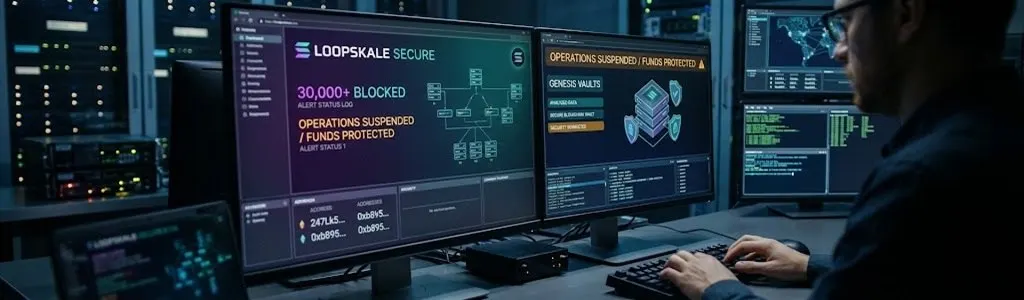
- The lending protocol Loopscale temporarily suspended all operations on November 5 after detecting a coordinated campaign of API attacks.
- The platform’s infrastructure received more than 30,000 malicious requests per day specifically targeting its SOL and USDC Genesis Vaults.
- The technical team confirmed that no deposit losses were recorded for users and that the impacted vaults were fully restored.
This Thursday, November 5, the decentralized lending protocol Loopscale, developed on the Solana network, suspended its operations. An offensive against its main vaults prompted this decision.
Over the past week, Loopscale has been targeted in a sustained campaign by a sophisticated actor, with the protocol APIs receiving more than 30,000 malicious requests per day. All deposited user funds are secured.
Earlier, our security systems detected a significant escalation…
— Loopscale (@Loopscale) November 5, 2026
The protocol team reported in a post on X that over the past seven days, they faced persistent activity attributed to a sophisticated attacker. Company records documented more than 30,000 daily malicious requests aimed at its application programming interfaces (APIs). Project leadership emphasized that all funds deposited by users remain protected.
According to Loopscale‘s technical report, internal systems identified a critical surge in intrusion attempts. Faced with this scenario, administrators decided to temporarily halt transactions to safeguard ecosystem liquidity.
The attack vectors were concentrated on the so-called Genesis Vaults tied to Solana (SOL) and USD Coin (USDC) assets. Despite recurring exploitation attempts, the team assured that the impacted vaults were fully restored and that no individual balances were compromised.
Technical detection and legal coordination
In its preliminary breakdown, the cybersecurity team traced four wallet addresses linked to the penetration attempts: 247Lk5…piR, AzPh2d…wMr, 0xb895…fb2, and 0xB7Ec…854.
Loopscale management stated that it is actively collaborating with federal law enforcement agencies and external auditing firms to determine the scope of the intrusion. The protocol announced that general functions will remain closed while additional perimeter defense mechanisms are deployed.
The company gave immediate priority to the gradual reactivation of the front-end interface and the repayment system to prevent borrowers from facing unplanned liquidations.
Unlike traditional decentralized finance models based on pooled liquidity funds, Loopscale operates via an order book connecting lenders and borrowers directly with fixed rates and overcollateralization. The temporary operational suspension halts new borrowing, capital deposits, and adjustments to open positions.
The digital asset industry documented a prior technical incident involving this same platform in late April 2025. On that occasion, a flaw tied to the price oracle and the manipulation of the RateX PT token resulted in the temporary drainage of approximately $5.8 million. That episode concluded with full fund recovery after a 10% bug bounty was negotiated.
The offensive reported by Loopscale coincides with other recent security incidents across the cryptocurrency market during the first week of November 2026.
Notable among them is regional exchange Mercado Bitcoin, which identified a breach estimated at $36.3 million on November 2. According to the entity, $12.9 million has already been frozen as part of containment measures, while customer balances remain protected under custody.
Similarly, the BitMart platform acknowledged a minor intrusion on November 2, according to public statements by its founder, Sheldon Xia. Concurrently, derivatives platforms Binance and Deribit revoked API keys linked to third-party vendor SignalPlus on November 5 due to preemptive infrastructure alerts.
Loopscale confirmed that the full restoration of protocol functions will take place upon completing joint forensic audits alongside federal investigators.
This story was originally published by Crypto Economy. Read the original article.