Nvidia Tumbles as AI Bubble Fears Spread, Bitcoin Falls Below $60,000
Wall Street questions AI valuations as Nvidia's stock plunges and crypto markets sell off in tandem
Nvidia shares have suffered a steep decline, according to reports published on November 21. Decrypt put the drop at roughly 48%, while CryptoBriefing described a decline of approximately 40%. Both accounts point to the same underlying story: a sudden and severe reassessment of the company long seen as the face of the artificial intelligence boom.
Nvidia's chips power much of the infrastructure behind generative AI systems. Its stock has served as a proxy for investor confidence in the sector as a whole. A decline of this magnitude, even accounting for the variation in reported figures, signals that confidence has been shaken.
Wall Street commentators cited in the reports are questioning whether AI-related valuations have climbed too far, too fast. The term "AI bubble" has circulated for months among analysts wary of concentrated gains in a small group of technology names. This selloff appears to be testing that thesis in real time.
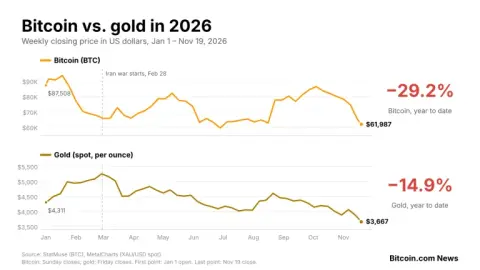
The tremor did not stay contained to equities. CryptoBriefing reported that Bitcoin fell below $60,000 as the AI bubble fears spread into crypto markets. This suggests a degree of correlation between risk appetite in tech stocks and digital assets, a pattern that has recurred during previous bouts of market stress.
Bitcoin and other cryptocurrencies have increasingly traded alongside high-growth technology stocks in recent years. Large institutional investors often hold both asset classes within the same risk-adjusted portfolios. When confidence in one falters, the other can be affected through shared investor positioning rather than any direct fundamental link.
The discrepancy between the two reported figures for Nvidia's decline, 48% versus roughly 40%, highlights how fast-moving and chaotic this kind of selloff can be. Prices can shift meaningfully within the same trading session, and figures captured at different moments may understandably diverge. Readers should treat both numbers as indicative of a sharp move rather than a precise, agreed-upon benchmark.
It remains unclear whether this marks the start of a sustained correction or a sharper, shorter-lived pullback. Markets have seen volatile swings in AI-adjacent stocks before without a lasting reversal in sentiment. Analysts will likely watch upcoming earnings reports and capital spending announcements from major technology firms for further signals.
For now, the episode underscores how tightly intertwined AI-driven equity enthusiasm and crypto market sentiment have become. A shock to one corner of the market can quickly ripple into the other, regardless of whether the underlying fundamentals are directly connected.
Market Impact
A sharp decline in Nvidia's share price carries weight beyond the company itself, given its outsized influence on technology indices and investor sentiment toward AI infrastructure spending. If the selloff extends, other chipmakers, cloud providers, and AI-adjacent firms could face renewed scrutiny over valuation levels built up during the sector's rapid ascent.
The simultaneous drop in Bitcoin below $60,000 points to renewed correlation between crypto and risk assets tied to the AI narrative. Traders positioned across both markets may face pressure to reduce exposure broadly, rather than treating equities and digital assets as separate risk buckets. Continued volatility in either market could feed back into the other in the days ahead.
Whether this represents the unwinding of an AI-driven bubble or a temporary shock will likely become clearer as more data and market reaction emerge in the coming weeks.
Frequently Asked Questions
How much did Nvidia's stock actually fall?
Reports differ, with one source citing a drop of roughly 48% and another describing a decline of about 40%. Both point to a severe, sudden selloff rather than a gradual decline.
Why did Bitcoin fall alongside Nvidia's stock?
Bitcoin and AI-related tech stocks have increasingly moved together as investors treat them as similar risk assets. A sharp selloff in one can prompt broader de-risking that affects the other.
Does this confirm an AI bubble is bursting?
Not necessarily. The reports describe a significant market reaction and rising concern among commentators, but it is not yet clear whether this is a lasting trend reversal or a short-term correction.
What should investors watch next?
Analysts are likely to focus on upcoming earnings and spending disclosures from major AI-linked companies, along with whether Bitcoin and tech stocks continue trading in tandem.
This story was originally published by The Coin Rise. Read the original article.