HYPE Rises 8% Before Franklin’s ETF Adds It. That ETF Holds About $17 Million

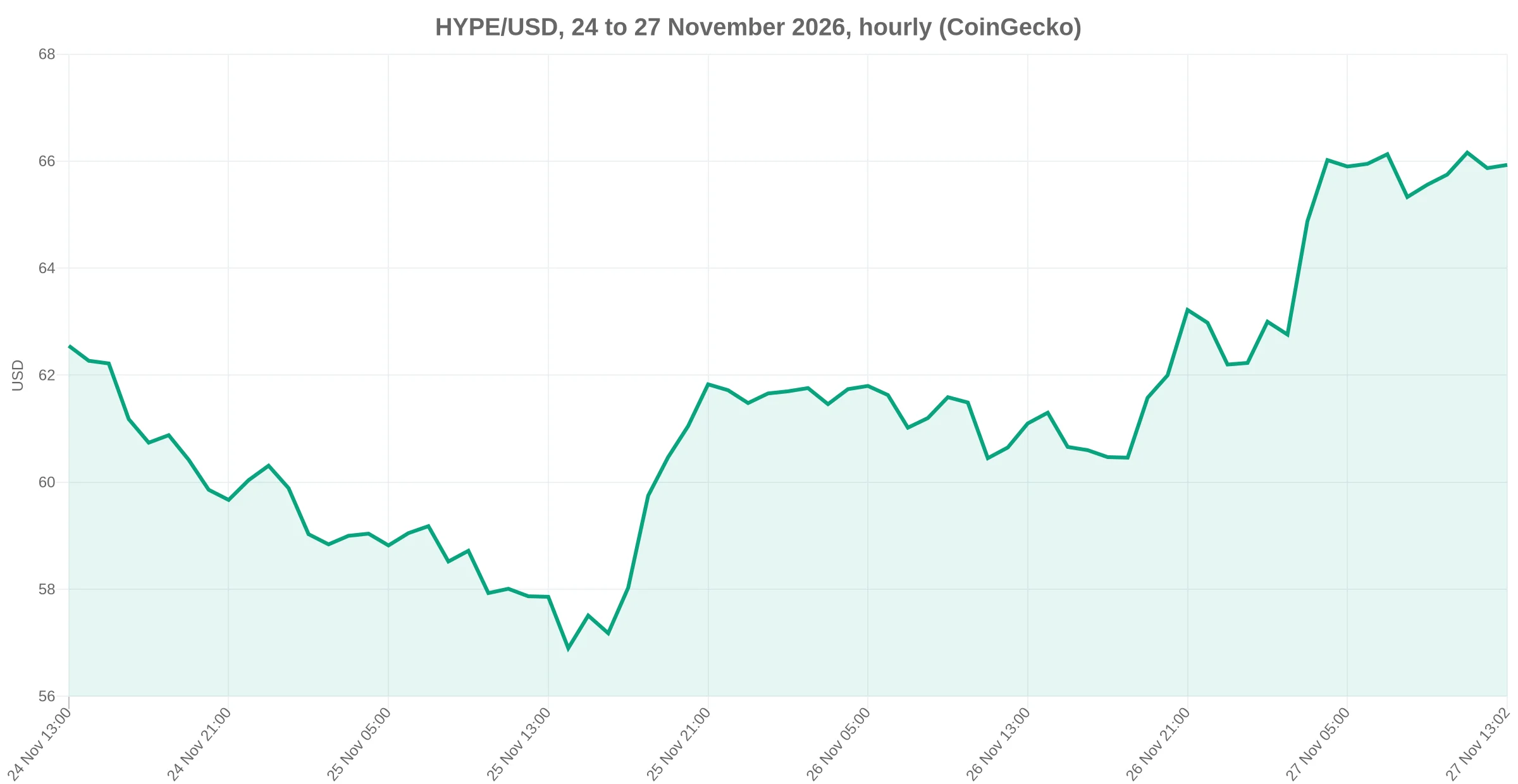
HYPE traded at $65.92 at 13:06 UTC on 27 November, up 7.8% in 24 hours while bitcoin added 1.2%. The story attached to the move is a filing: Franklin Templeton’s Crypto Index ETF, ticker EZPZ, will hold Hyperliquid’s token from about 1 December because the index it tracks admits HYPE that day. The filing is real. The buying it implies is small enough to fit inside a single block trade.
The fund reported $17.02 million in net assets at 30 September in its latest quarterly report. If HYPE lands at roughly 1% of the index, the ETF would buy about $168,000 of the token. HYPE traded $923.2 million across spot venues in the past 24 hours, so that purchase equals 0.018% of one day’s trading. The index weights are not published yet and the fund has not disclosed a quantity, which makes this arithmetic rather than a forecast.
The supplement that put HYPE inside the fund
Franklin Crypto Trust filed Prospectus Supplement No. 1 on 25 November, amending a prospectus dated 1 December 2025. It states: “CF Benchmarks Ltd. (“Index Provider”) has announced that effective December 1, 2026, the Underlying Index will add Hyperliquid (“HYPE”) as a new digital asset constituent.”
The decision belongs to the index provider, not to Franklin’s analysts. CF Benchmarks published the reconstitution notice on 16 November: “The Administrator announces that the Reconstitution of the CF Digital Asset Index Family Multi Asset Series will take place on December 1st, 2026.” HYPE is the only addition the notice lists for the CF Institutional Digital Asset Index.
The fund can hold the token without a fresh exchange filing because the generic listing standards already cover assets that join its index. From the supplement: “In reliance on the rules adopted by Cboe BZX Exchange, Inc. and approved by the U.S. Securities and Exchange Commission (SR-CboeBZX-2025-104) (the “Generic Listing Standards”), the Fund is permitted to hold additional digital assets that are constituents of the Underlying Index.”
Then the operative sentence: “Accordingly, on or about December 1, 2026, the Fund will invest in Bitcoin, Ether, XRP, Solana, Dogecoin, Cardano, Stellar Lumens, and HYPE in approximately the same weights as they represent in the Underlying Index.”
Three things are absent from that sentence. No weights, no quantity, and no statement about where inside “on or about” the purchase falls. A passive fund does not choose the size of a position or the day it is taken. The index decides both, and the index publishes its weights when the reconstitution takes effect.
Eight constituents, and the weights that existed before HYPE
The most recent published weights sit in the 10-Q for the quarter ended 30 September: Bitcoin 76.58%, Ether 12.69%, XRP 5.35%, Solana 3.75%, Dogecoin 0.76%, Cardano 0.53%, Stellar Lumens 0.34%. Seven assets, adding to 100%. The eighth, HYPE, enters on 1 December and takes its share from the other seven.
Those numbers follow free float rather than headline market value: “The Digital Assets included in the Underlying Index are weighted based on their free float market capitalization as determined by the Index Provider.” The reconstitution workbook also files HYPE in the index family’s DACS taxonomy as Settlement, Programmable, Specialized Purpose Smart Contract Platforms, one level below the general-purpose bucket that holds Ethereum and Solana.
Using circulating market values at 13:00 UTC, the eight constituents would total $1.588 trillion and HYPE’s $15.67 billion would be 0.99% of it. Free-float adjustments can move that figure either way, because HYPE’s circulating supply of 237.65 million tokens is a quarter of the 949.8 million that exist. Treat 0.99% as a working estimate with a stated method, not as a published weight.
What one percent of a $17 million fund buys
0.986% of $17,024,864 is $167,865. At $65.92 that is 2,547 HYPE.
Set that against the market it is meant to serve. HYPE’s market value is $15.67 billion, which makes the entire ETF 0.11% of the asset. The fund’s whole portfolio equals 1.8% of the $923.2 million of HYPE that changed hands on spot venues in the past 24 hours. On Hyperliquid’s own venue the HYPE-USD perpetual traded $479.4 million in the same window and carried $642.2 million of open interest, according to CoinGecko’s derivatives feed at 13:03 UTC. The estimated ETF purchase is 0.035% of that perpetual volume.
The mismatch survives growth. Were EZPZ to triple its assets to $51 million, the HYPE slice would come to roughly $505,000, or about 7,660 tokens at today’s price. A fund of that size still cannot absorb a day of Hyperliquid’s order flow, and it does not need to: its job is to mirror an index, not to build a position in anticipation of one.
A rebalance is not an inflow
Index inclusion does not deliver new money to the fund. The HYPE weight has to come out of the existing seven holdings, which is what the quarterly rebalance does: bitcoin’s 76.58% becomes about 75.82%, ether’s 12.69% becomes about 12.56%, XRP’s 5.35% becomes about 5.30%, and the smaller weights shrink in proportion. On a $17.02 million portfolio, funding a 0.99% HYPE position means selling roughly $168,000 of everything else. A bit more than $128,000 of that comes from bitcoin alone.
Cash only arrives when authorised participants create shares. In the third quarter the fund issued 100,000 shares for $1,608,688 and redeemed 100,000 for $1,981,975, a net redemption of $373,287. Net assets still rose over the quarter because the assets inside the fund rose, not because investors added money. The fund closed September with 800,000 shares, $17.02 million in net assets and a net asset value of $21.28 per share, and charges 0.19% a year.
That distinction matters to anyone reading an ETF headline as demand. A rebalance among existing holdings produces no net inflow, and a passive fund’s purchase is capped by its own size at the moment of the trade.
The timeline argues against the ETF story
HYPE fell to $56.90 on 25 November, the day the supplement was filed. The CF Benchmarks notice had been out since 16 November. The rally started two days later: $61.30 at 14:00 UTC on 26 November, a low of $60.46 at 18:00, then $66.02 by 04:00 UTC on 27 November and a high of $66.16 at 11:00. That is 7.8% over 24 hours and 9.4% off Thursday’s low, and it leaves HYPE 18.1% below its price 30 days ago and 32.7% under the $97.96 record set on 23 September.
If a few hundred thousand dollars of mechanical buying were the cause, the reaction should have arrived when the news landed, not 48 hours later. The filing cannot explain the timing on its own, and the data available at 13:00 UTC does not identify what did.
What the window does show is that positions on Hyperliquid’s own contract dwarf the ETF: $642.2 million of open interest against an estimated $167,865 purchase. Open interest in dollar terms also rises when the underlying rises, so the figure alone does not prove that new positions were opened. It does show where the marginal price discovery happens, and it is not in a $17 million index fund.
The other ways to own HYPE are larger and more direct
HYPE already reaches investors through vehicles that are not index funds. Hyperliquid Strategies, the Nasdaq-listed HYPE treasury that trades as PURR, applied in November to become a US futures broker; its results are marked against the token rather than against a basket. Those structures take concentrated exposure and, in the case of a listed company, can trade at a premium or discount to the assets they hold.
The exchange-listing route has moved faster than the index route. When Upbit opened won, BTC and USDT markets for HYPE on 10 November, the token held near $73 and Korean retail access widened without any change to a benchmark. Index inclusion is a slower, more mechanical channel: it adds a permanent small bid on rebalance dates and nothing in between.
What to watch before 1 December
The number that decides the purchase size is the reconstitution file CF Benchmarks publishes for 1 December, not the supplement. The fund’s next 10-Q will show whether share creations grew assets enough for a 1% slice to matter. And the quarterly schedule cuts both ways: an asset that enters by rule can leave by rule, which is a risk the supplement acknowledges in its language about constituents being added or removed under the index provider’s rules.
For HYPE holders the practical question is whether $17 million of assets and a 0.99% weight can carry the weight the headline implies. The fund will buy in December, in some size. The arithmetic says the token’s price will be set elsewhere.
Frequently Asked Questions
When does HYPE enter the Franklin Crypto Index ETF?
On or about 1 December 2026. CF Benchmarks adds HYPE to the CF Institutional Digital Asset Index on that date, and the fund’s 25 November prospectus supplement says it will invest in the eight constituents in approximately the same weights as the index.
How much HYPE will EZPZ buy?
The fund has not disclosed a quantity or the new weights. At the last reported net assets of $17.02 million and an estimated 0.99% index weight, the position would be about $168,000, or roughly 2,547 tokens at $65.92. That estimate uses circulating market values and can change once CF Benchmarks publishes its official weights.
Does index inclusion bring new money into HYPE?
Not by itself. The HYPE position is funded by trimming the existing seven holdings during the rebalance, so the trade is neutral for the fund’s total assets. New cash only enters if authorised participants create shares, and in the third quarter the fund had net redemptions of $373,287.
Why did HYPE rise 8% on 27 November?
The available data does not establish a cause. The index decision was announced on 16 November and the prospectus supplement was filed on 25 November, the same day HYPE traded at $56.90. The rally began on the evening of 26 November and extended into 27 November, with open interest of $642.2 million on the HYPE-USD contract. Timing alone makes the filing an incomplete explanation.
Can HYPE be removed from the index later?
Yes. The supplement states that other constituents may be added or removed over time under the index provider’s rules and the generic listing standards, and that the index remains subject to a quarterly rebalancing schedule. Inclusion is a rule-based status, not a permanent one.
Data: SEC 424B3, SEC 10-Q, CF Benchmarks, CoinGecko, CoinGecko derivatives. Prices are the CoinGecko snapshot at 13:06 UTC on 27 November 2026; derivatives data is from 13:03 UTC.
This story was originally published by Blockchain Reporter. Read the original article.