Ethereum Sets Glamsterdam for Dec. 15 on Hoodi After Keeping EIP-8037

Ethereum’s next testnet fork finally has a timestamp. Core developers closed Thursday’s consensus call by scheduling Glamsterdam on Hoodi at epoch 143616, which lands on Dec. 15 at 19:12:24 UTC. That is 50 days after the fork was first due on Oct. 26. Ethereum’s mainnet has no date at all.
The agenda for All Core Devs Consensus #192 had framed the choice bluntly: set a Hoodi fork date in the week of Dec. 14 if execution clients were ready, or postpone. They were ready, on a specification that several of their own engineers had spent three weeks arguing against. The room picked the 15th over the 16th, and the fork now sits 19 days away.
Two Decisions, One Call
The meeting summary published on the Fellowship of Ethereum Magicians records two decisions that had been open since mid-November. The first covered the execution layer: “The execution layer teams reached a rough consensus to proceed with the current Glamsterdam spec as is, despite some concerns about potential breakage and the usability of the gas opcode.”
The second covered how consensus clients validate the payload a builder hands them. Two pull requests were on the table. PR 5770 imports RLP encoding into the consensus layer, a fix one participant called a hack but which cannot split the chain. PR 5820 was the cleaner design and the consensus-breaking one. The summary states that “the consensus layer teams then decided to adopt the non-consensus-breaking PR5770 solution for builder payload validation, which involves importing RLP into the consensus layer.”
Neither choice was a technical triumph. Both were decisions to stop debating and ship, which is what a fork schedule requires. The alternative was another unscheduling, and Hoodi has already had one this autumn.
Why the Fork Slipped 50 Days
Hoodi was supposed to fork on Oct. 26 at epoch 132352. That date lived in the testnet’s configuration files, not in a press release, and it left the same way: the unscheduling pull request merged on Oct. 22 removed the fork timestamp, every Gloas parameter attached to it, and the gas-limit schedule that went with the fork. The network went back to running pre-Glamsterdam code with no activation epoch in its genesis file.
The gap between October and December was not a testing failure. It was a specification argument. EIP-8037 rewrites how Ethereum charges for creating state, and the audits commissioned around it found edge cases in code that had been treated as settled for years. Besu’s team put the choice in writing on Nov. 19, two days before the execution call: “We prefer option 1, and discourage moving forward with breaking changes,” wrote Besu’s jflo, describing a narrow revision to EIP-8037 that would have sacrificed Sepolia’s testnet schedule but preserved the specification.
Their preferred option lost. What shipped instead is the unmodified specification, with the concerns recorded in the meeting notes rather than resolved in code. BlockchainReporter covered the audit findings earlier this month in the review of the eight invariants auditors were asked to break.
What Is Actually in Glamsterdam
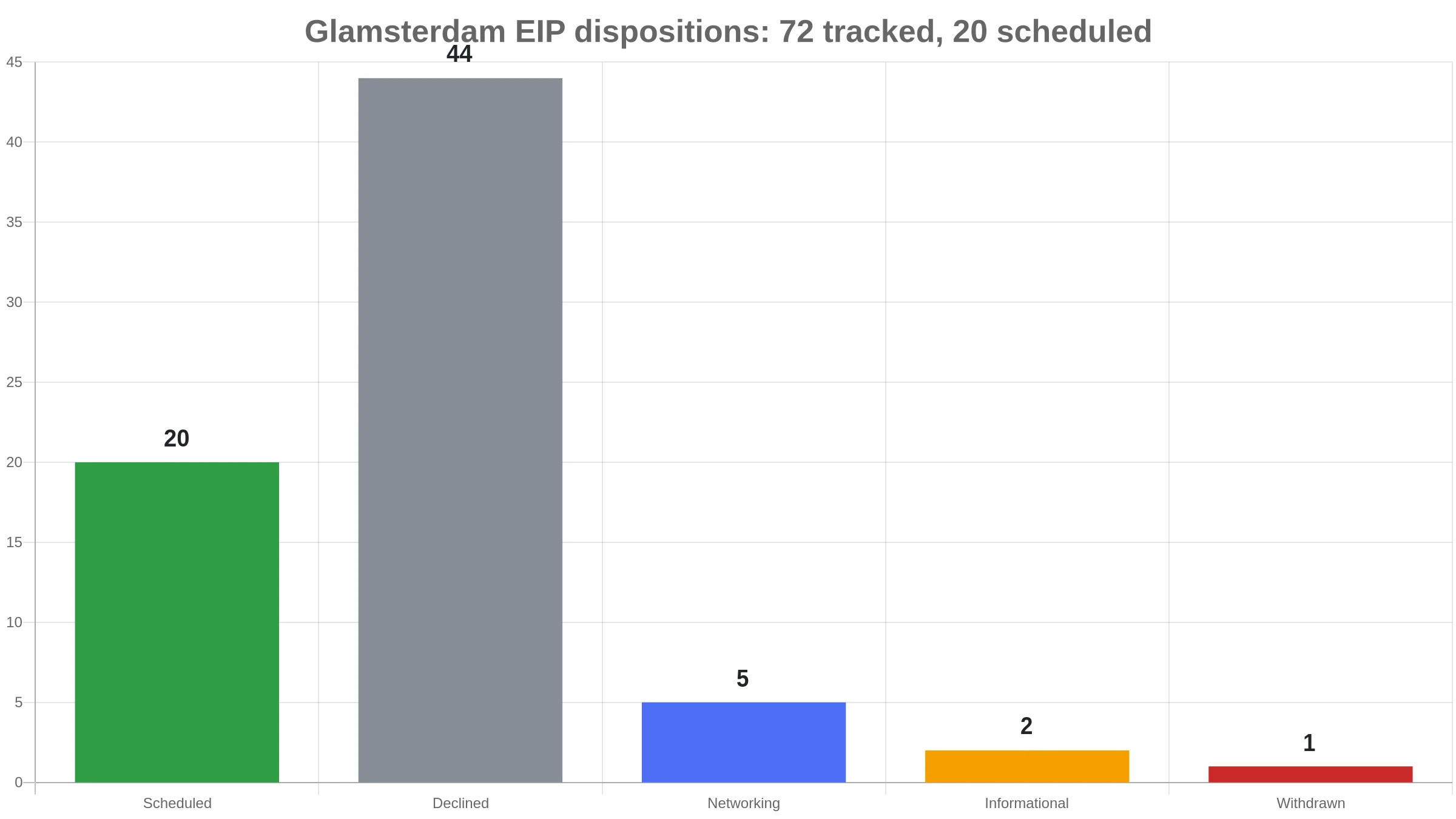
The scope is larger than the two headliners most coverage focuses on. The ethereum/forkcast upgrade tracker lists 72 EIPs as tracked for Glamsterdam: 20 scheduled, 44 declined, five networking, two informational, one withdrawn. The 20 scheduled for the fork are:
| EIP | Title |
|---|---|
| 2780 | Resource-Based Intrinsic Transaction Gas |
| 7495 | SSZ ProgressiveContainer |
| 7688 | Forward Compatible Consensus Data Structures |
| 7708 | ETH Transfers Emit a Log |
| 7732 | Enshrined Proposer-Builder Separation |
| 7778 | Block Gas Accounting without Refunds |
| 7843 | SLOTNUM Opcode |
| 7916 | SSZ ProgressiveList |
| 7928 | Block-Level Access Lists |
| 7954 | Increase Maximum Contract Size |
| 7976 | Increase Calldata Floor Cost |
| 7981 | Increase Access List Cost |
| 7997 | Deterministic Factory Contract |
| 8024 | Backward Compatible SWAPN, DUPN, EXCHANGE |
| 8037 | State Creation Gas Cost Increase |
| 8038 | State-Access Gas Cost Update |
| 8045 | Exclude Slashed Validators from Proposing |
| 8061 | Increase Exit and Consolidation Churn |
| 8246 | Remove SELFDESTRUCT Burn |
| 8282 | Builder Execution Requests |
The two headliners do different jobs. EIP-7732, enshrined proposer-builder separation, “separates the Ethereum block into consensus and execution parts and lets the consensus proposer choose the execution proposer,” per the tracker’s own description. That moves the heavy work of broadcasting and validating a full payload off the critical path of the slot. EIP-7928, championed by Toni Wahrstätter, introduces block-level access lists: instead of each transaction declaring the state it will touch, the block carries one enforced list with post-transaction state diffs, which lets clients fetch accounts and storage in parallel before execution starts.
The rest of the list is the unglamorous plumbing that decides whether those two features are usable. Six of the 20 EIPs touch gas accounting. Two touch SSZ container formats. One raises the maximum contract size, one adds three EVM opcodes, one extends exit and consolidation churn, and one removes the burn previously attached to SELFDESTRUCT. A 20-of-72 inclusion rate is normal for an Ethereum fork, and it is why nobody who follows the process describes the upgrade as a single feature.
The Number That Nearly Held the Fork
EIP-8037 is the reason Hoodi is forking in December instead of October. The proposal increases and separates the gas cost of creating state, so that contracts that write new accounts and storage slots pay closer to the cost their data imposes on every future node. EIP-8038 does the same for state access. Together they are the least visible and most disruptive part of the upgrade, because a contract that was cheap to deploy for five years can become expensive overnight without any bug in its own code.
Besu’s objection was narrow and technical. The client team asked for the specification to be revised “extremely narrowly to address the new behavior of remaining gas increasing,” in jflo’s Nov. 19 comment, rather than shipping the change as written. The alternative they floated was removing EIP-8037 from Glamsterdam and moving it to Hegotá, the following fork. That option would have left block-level access lists without the pricing that makes them worth having, which is why it lost.
What developers accepted instead is a specification that audits have already strained. The practical consequence for mainnet is that contract teams now have a testnet window, not a mainnet one: Hoodi is where they find out which of their deployments break, and Dec. 15 is when that clock starts.
Three Times the Gas Ceiling
The configuration change that carries the fork does more than set a date. The Hoodi pull request opened on Nov. 26 restores the Gloas parameters removed in October and schedules the testnet’s gas limit to rise to 200 million at the fork epoch. It states the activation parameters directly: “Gloas/Amsterdam now activates at epoch 143616 (slot 4595712, an accumulator boundary), timestamp 1797361944, Tuesday 15 December 2026 19:12:24 UTC.”
The arithmetic behind that gas number is the part worth keeping. Ethereum’s chain head at 09:20 UTC on Nov. 27, block 26,505,603, carried a gas limit of 60 million. Lifting Hoodi to 200 million multiplies the per-block ceiling by 3.33. At 12-second slots that is a move from 5 million gas per second to 16.7 million gas per second, and it is the same direction the mainnet gas-limit debate has been heading for months. BlockchainReporter covered the client-side work on that ceiling in the report on Prysm’s 200 million gas fix.
One caveat belongs in the same paragraph as the number: the scheduled value binds only validators that never set their own preference. EIP-8261, one of the two informational EIPs tracked for this fork, gives consensus clients a list of gas-limit changes by epoch so the network can raise the limit without waiting for every operator to install a new release. It is advisory. A proposer can still exceed it, and non-adopting clients keep coordinating by hand.
The Pull Request Is Still Open
As of 09:25 UTC on Nov. 27, the Hoodi pull request that actually schedules the fork was open, unmerged, and had no review comments. That is not a warning sign; it is how Ethereum testnet changes land, with the client release and the config file merged in sequence after the call. But it does mean the date agreed on Thursday is a decision, not yet a shipped parameter. Clients reading Hoodi’s genesis file today still see no activation epoch.
Hoodi is the last public testnet before mainnet for this fork, and its history is a reminder of how provisional testnet dates are. The October date existed in configuration for weeks and disappeared in a single merge. The December date has the same status until the fork activates and the chain follows the new rules.
Mainnet Is Still Undated
Nothing in the Nov. 26 decisions sets a mainnet block, epoch, or month. The forkcast tracker lists Glamsterdam as upcoming with an activation label of TBD. It carries a projected activation of Jan. 27, 2027, which is the tracker’s planning estimate and not an announced date; anyone quoting it as a schedule is reading a guess as a commitment.
The calendar does have two fixed points. All Core Devs Testing meets on Nov. 30 for call #105, and All Core Devs Execution meets on Dec. 3 for call #250, where the mainnet conversation would normally resume if Hoodi behaves. The same consensus call deferred the Hegotá scope question: the summary records that no final decision was made on FOCIL, the fork-choice enforced inclusion list proposed as that fork’s headliner, and that the full scope will be revisited at the next call.
What It Changes for ETH Holders
Ether traded at $1,730.01 at 09:25 UTC, up 1.73% over 24 hours inside a range of $1,667.94 to $1,755.22, according to Binance’s ETH/USDT market; Coinbase’s ETH/USD spot printed $1,729.54 in the same window. The chain head’s base fee at 09:20 UTC was 0.119 gwei, which tells you blocks are not full and users are not competing for space.
That context matters for reading the upgrade. A 3.33x gas ceiling on a testnet is preparation for demand that does not exist yet, not a response to congestion. ePBS changes who builds blocks and what a proposer must trust, which affects MEV distribution and validator operations more than it affects supply. No EIP in the scheduled list changes issuance. The holders’ exposure is indirect: lower fees and higher throughput are the pitch for using Ethereum, and both are being tested on a network that has already missed one date.
Frequently Asked Questions
When does Glamsterdam activate on Hoodi?
Dec. 15, 2026 at 19:12:24 UTC, at epoch 143616 and slot 4595712, according to the Hoodi configuration pull request opened after the Nov. 26 consensus call.
Is there a mainnet date for Glamsterdam?
No. Core developers have not set a mainnet block, epoch, or month. Forkcast’s projected activation of Jan. 27, 2027 is a planning estimate, not an announcement.
What does EIP-8037 change?
It increases and separates the gas cost of creating state, so new accounts and storage slots pay closer to their long-term cost to the network. Execution clients approved shipping it unchanged on Nov. 26 after Besu argued for a narrow revision.
What is enshrined proposer-builder separation?
EIP-7732 splits the block into consensus and execution parts and lets the consensus proposer choose the execution proposer, moving payload broadcast and validation off the slot’s critical path. It is one of the two headliners of the fork, alongside block-level access lists in EIP-7928.
Will Glamsterdam raise or lower Ethereum fees?
It will raise the gas cost of some operations, particularly ones that create or access state, through EIP-8037 and EIP-8038, and reduce others through block-level and transaction-level access list changes. Fees users pay still depend on block space demand; the base fee was 0.119 gwei at 09:20 UTC on Nov. 27.
What happens after Hoodi forks?
If Hoodi activates cleanly, the mainnet date becomes the next decision at the execution and consensus calls in December. All Core Devs Testing meets Nov. 30 and All Core Devs Execution meets Dec. 3.
Data: Coinbase, Binance ETH/USDT, Ethereum public RPC, Forkcast, ethereum-rpc.publicnode.com. This article is not investment advice.
This story was originally published by Blockchain Reporter. Read the original article.