Crypto Investors Can Now Buy Copper – Delivery Has a Catch
Key Takeaways
- Redemption minimum: 125 kg interview, 25-tonne draft
- Reserve: 24,968 kg in ten Hamburg bundles
- Holding fees: 0.85% target, up to 1.1%
- No formal peg to copper spot price
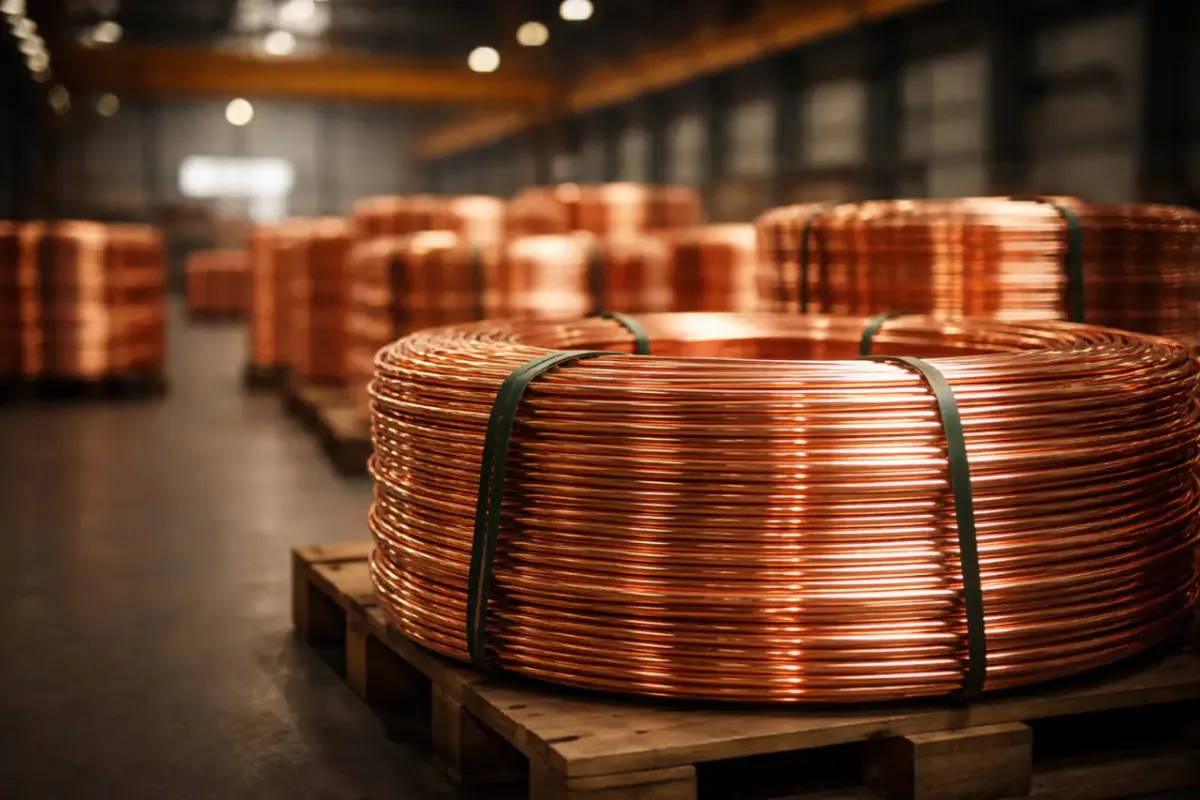
The platform issued 25,000 xCu tokens, each tied to one kilogram of refined copper and together valued at about $366,000, CoinDesk reported on November 2.
Who holds the copper behind each token
Metals.io describes xCu as beneficial ownership of copper held through a trustee. The trustee holds the metal on the holders’ behalf, and the token is the register entry recording each holder’s share. Structures like this are generally used to keep the asset separate from the platform operator’s own balance sheet, although Metals.io’s risk summary still lists dependence on custodians and other providers among the product’s risks.
Interface
Trilitech, a London-based Tezos development company, runs the trading platform. The site terms name Trilitech Design Limited as interface operator, separate from custody and token issuance.
Trustee
Archax, a UK-regulated digital asset platform, acts as trustee and checks that stored copper matches circulating token supply.
Warehouse
C. Steinweg Hamburg holds the cathodes, according to the reserve document Metals.io links.
Holder
Owns a share recorded onchain. Releasing physical metal requires an approved custody account and identity checks.
The published description places the copper in bonded warehouses in Germany and the Netherlands, meaning storage where import duties and taxes are suspended until the metal leaves. The only reserve document linked so far covers Hamburg.
That document, an October 23 transfer confirmation, records 24,968 kilograms of Comika copper cathodes received at the Hamburg site, 32 kilograms fewer than the 25,000 tokens CoinDesk reported. A transfer record captures one moment. Matching inventory against circulating supply needs a dated reconciliation from the trustee that accounts for later movements and any tokens created to pay fees, a mechanism explained further down.
125 kilograms or the whole reserve
Buying xCu requires no minimum. Collecting the copper does, and Metals.io’s three published sources describe it differently.
CoinDesk interview
November 2, 2026
About 125 kg, the weight of one cathode sheet. Holders also need a suitable storage account and must pass identity and anti-money laundering checks.
Live disclosure
Delivery limited to approved custody-account holders, subject to minimum sizes and warehouse procedures. No fixed quantity given.
September 2026, marked DRAFT
Warehouse minimums typically of one 25-tonne lot.
The interview figure follows the physical unit. Elvidge told CoinDesk that each cathode sheet weighs about that much, and a warehouse releases whole sheets. At the launch valuation of roughly $14.64 per kilogram, one sheet represents about $1,830 of copper, before redemption, transport or storage costs.
The draft’s figure leads somewhere else entirely. The October 23 confirmation shows the Hamburg reserve arrived as ten bundles of about 2.5 tonnes each, which together make up almost exactly one lot of the size the draft describes. Under that rule, the only holder able to redeem would be one owning effectively the entire $366,000 issuance.
The product page leaves the number open. A buyer who intends to collect metal needs three things confirmed in the governing custody terms: the current minimum, the receiving account and the release procedure.
Why the redemption door sets the token’s price
The product page states that xCu has no formal peg to copper’s spot price. What usually keeps an unpegged, metal-backed token near its benchmark is arbitrage. When the token trades below the value of the copper behind it, someone can buy tokens cheaply and redeem them for metal. A premium is checked from the other side by new issuance, which Elvidge said would depend on investor demand.
Only holders who can redeem can close a discount. Someone without an approved custody account, or holding less than the minimum, has one exit: selling to another buyer on Metals.io’s platform, where xCu trades around the clock. The narrower the redemption door, the fewer participants can pull the token back toward copper, and the longer a gap can last. Market makers may help align prices, the product page says, but it leaves premiums and discounts possible.
The launch valuation implies about $14,640 per tonne. LME cash copper settled at $14,415 per tonne on October 23, according to Westmetall’s record of official LME prices, about 1.6% lower. Without a stated valuation date or a trading history, that gap is a starting comparison rather than a measured premium. It is the comparison a buyer should keep making, because a rise in the LME benchmark reaches an xCu holder only through the token’s own market.
Depth matters too. A $366,000 issuance trading on a single platform tests the question Coindoo raised in Ethena’s plan to use tokenized gold as collateral: whether a position can be sold in the size needed, at the moment needed.

How a 10 ETH Refund Bug Froze THORChain Trading on 10 Chains
How fees eat into the kilograms
Holding costs come out of the copper itself. The draft whitepaper says ongoing fees accrue as daily credits to a treasury wallet, and each holder’s fractional ownership share falls as they do. The wallet shows the same token count while the metal behind it shrinks, so one token per kilogram holds at issuance and drifts lower afterwards.
At the draft’s 0.85% annual target, 1,000 tokens would correspond to roughly 992 kilograms after a year. At the product page’s disclosed maximum of 1.1% a year for custody and administration, the figure is closer to 989 kilograms. The draft gives a target; the product page gives the ceiling currently disclosed.
Trading costs come on top: a 0.1% protocol fee plus a liquidity-provider fee of up to 0.5% on every trade. A buyer who enters, holds for a year at the disclosed maximum and then sells could pay up to about 2.3% in combined fees, roughly $23 on a $1,000 position. That total leaves out spreads, slippage, network costs, payment charges and any redemption expenses.
Where the token can travel
xCu moves only between eligible wallets. The current FAQ restricts which addresses can hold it and says lending and borrowing against the token are not yet supported. The draft’s discussion of using xCu as collateral describes a possible future integration rather than a live one.
Metals.io’s risk summary lists redemption delays, limited liquidity and reliance on custodians and other providers. It also states the investment falls outside the Financial Services Compensation Scheme, the UK fund that compensates customers of failed financial firms. Archax’s regulation governs its conduct as trustee. The token’s price and the delivery terms remain the holder’s risk.
The case for xCu, and the records that would settle it
The product has real strengths. It holds refined, branded cathodes already sitting in a warehouse, rather than claims on metal still in the ground. It allows entry at any size, trades at any hour and uses a regulated trustee to check supply against inventory. Metals.io already runs tokenized uranium and gold products with market values of about $9.2 million and $4.1 million, according to CoinDesk, and Elvidge said the company was deliberately starting small with copper.
The established route into stored copper is Sprott’s exchange-listed physical copper trust, whose units trade during stock-market hours. xCu offers a different arrangement for the same underlying exposure: smaller tickets and continuous trading, in exchange for a single trading venue and redemption terms still being settled.
Four records would close the open questions: a final whitepaper replacing the draft, custody terms that state the redemption minimum, a dated trustee reconciliation of inventory against circulating tokens, and a public price history showing how xCu has traded against LME copper. Those documents will show whether a holder’s claim on the metal works in practice for holdings of every size, or mainly for the largest ones.
This story was originally published by Coindoo. Read the original article.