Chainflip Lost $4.88M From Its Ethereum Vault in One Signed Batch. FLIP Broke Two Hours Later

Chainflip’s Ethereum vault released $4.88 million in a single call at 07:10:59 UTC on Nov. 21. The transaction, visible on Blockscout, moved 520.2243 ETH, 3,249,631.41 USDC and 758,141.33 USDT out of the vault contract that Chainflip’s own documentation lists as its Ethereum Vault.
At the ETH price of $1,681.11 that CoinGecko recorded at 18:00 UTC, the three transfers are worth about $4.88 million together. The stablecoins alone account for 82% of that total. Chainflip has not published an incident report, a post-mortem or a governance proposal about the transaction. Its site displays a single line to every visitor: “Chainflip services are temporarily unavailable.”
The token took the damage on a delay. FLIP traded at $0.4825 an hour after the drain, was still at $0.4728 at 09:00 UTC, and hit $0.2886 by 11:00. It has since recovered to $0.327, down 31.7% over 24 hours against a Bitcoin price that rose 1.79% and an Ether price that rose 3.34% in the same window. The loss is roughly 17% of FLIP’s $28.1 million market capitalisation.
One call, three assets, 07:10:59 UTC
The transaction is not a contract exploit in the usual sense. There was no reentrancy, no flash loan, no oracle manipulation and no drained approval. The vault contract at 0xF5e10380213880111522dd0efD3dbb45b9f62Bcc executed a transferBatch call, a routine administrative function that batches several token transfers into one transaction, and the batch pointed at a single recipient: 0x7d14a719072DA80076b4edcec3e3401209d21Eaf.
All three assets left in the same block, to the same address, which has no earlier transfer history on Blockscout. The recipient held 0.000013 ETH after moving the funds on. That structure separates two different questions: whether the vault contract behaved as designed, and whether the authority to command it was obtained legitimately.
The contract behaved as designed. It released funds because the transaction carried a signature its verification logic accepts. Chainflip’s protocol does not give any single operator a key to the vault; it gives the validator set a way to produce one signature together, and the contract checks that signature before it moves anything. The breach, if there is one, sits upstream of the contract.
The vault accepted a signature, and the sender is not the signer
The wallet that submitted the transaction, 0x78fa4aC270DB14886033e95b9B9E93F887aA2db0, has exactly one transaction in its history: this one. It still holds 0.9931 ETH. That detail reads like a smoking gun and probably is not one. Chainflip’s normal egress batches also arrive from one-off relayers, and the vault has processed more than a dozen of them since 05:00 UTC today, each from a different address, each an allBatch call. A fresh sender is the routine shape of a relayer, not evidence of a compromised machine.
What matters is the signature, not the sender. Chainflip uses a threshold Schnorr scheme called FROST, and its technical documentation describes the setup in one sentence: “At vault creation, N selected parties perform a ceremony to create a single aggregate key for the vault or wallet.” The same page puts the target at “a 100 of 150 system for all supported chains”. A valid aggregate signature therefore means that at least the threshold number of key shares participated, or that enough shares were collected somewhere else and combined.
That is the open question the on-chain record cannot answer. A signature that verifies proves the threshold was met. It does not prove that the validators who hold those shares intended to meet it, and it does not distinguish a compromised host from a compromised operator from a flaw in how shares are stored. Chainflip’s August incident, which the team described as an attempted exploit involving cross-chain messages and refunds, was stopped before funds left. This one was not.
The comparison that matters for anyone holding FLIP is not the size of this loss. It is the shape. A protocol that loses funds to a bug loses them once, patches the bug, and moves on. A protocol that loses funds to a signature loses them again unless every validator holding a share is re-provisioned. BR covered the same failure mode in the $24 million AFX Trade drain, where compromised bridge keys did the work that a smart contract bug could not.
Six minutes to the exit, then five hours of peeling
The money did not sit still. Two minutes after the drain, at 07:12:59, the recipient forwarded 3,249,631.41 USDC to 0x3416cF6C708Da44DB2624D63ea0AAef7113527C6. At 07:14:23 it forwarded 758,141.33 USDT to the same address. At 07:16:59 it moved 542.6734 ETH to 0xfd24197eF8503dd5dd18F30C7B86A77910D3B080, and over the next hundred minutes the same 542.6734 ETH reappeared in further transfers to two more addresses, 0xfd24bacA811050A2AF3660ce36dB5BB58489B080 and 0xfD21A5bB594983c38C781E1Ce4eD6B32e0D3B080.
The repeated amount is the tell. 520.2243 ETH from the vault, plus 21.1363 ETH and 1.3138 ETH that arrived from the same router address in the following four minutes, add up to roughly 542.67 ETH. The identical figures moving between fresh addresses are hops of one balance, not separate thefts, and anyone summing them will overstate the loss by a factor of five.
AMLBot, a blockchain analytics firm, told readers that the stablecoins were swapped to ETH within four minutes and that most of the proceeds reached Tornado Cash within nine. “We believe the laundering was scripted and automated end to end,” the firm said, as reported by crypto.news. BR did not observe either address sending funds into a mixer directly; that part of the account rests on AMLBot’s tracing rather than on our own read of the chain. What is verifiable is the part that matters for recovery: the stablecoins left the vault in one batch, hit a single intermediary, and were forwarded out of it inside four minutes, before any issuer freeze could realistically be arranged.
That speed is not an accident of this incident. It is the standard playbook for a vault drain in 2026, and it is why the size of a loss is usually decided in the first ten minutes rather than the first ten days.
FLIP did not break at 07:10
The market’s response is the most interesting part of the record, because it does not match the story most readers will assume. Between 07:00 and 09:00 UTC, FLIP barely moved: $0.483 at 07:00, $0.4825 at 08:00, $0.4728 at 09:00. The break came between 09:00 and 11:00, when the token fell to $0.2886, a 39% decline from the morning level, and the seven-day chart below shows the vertical leg clearly.
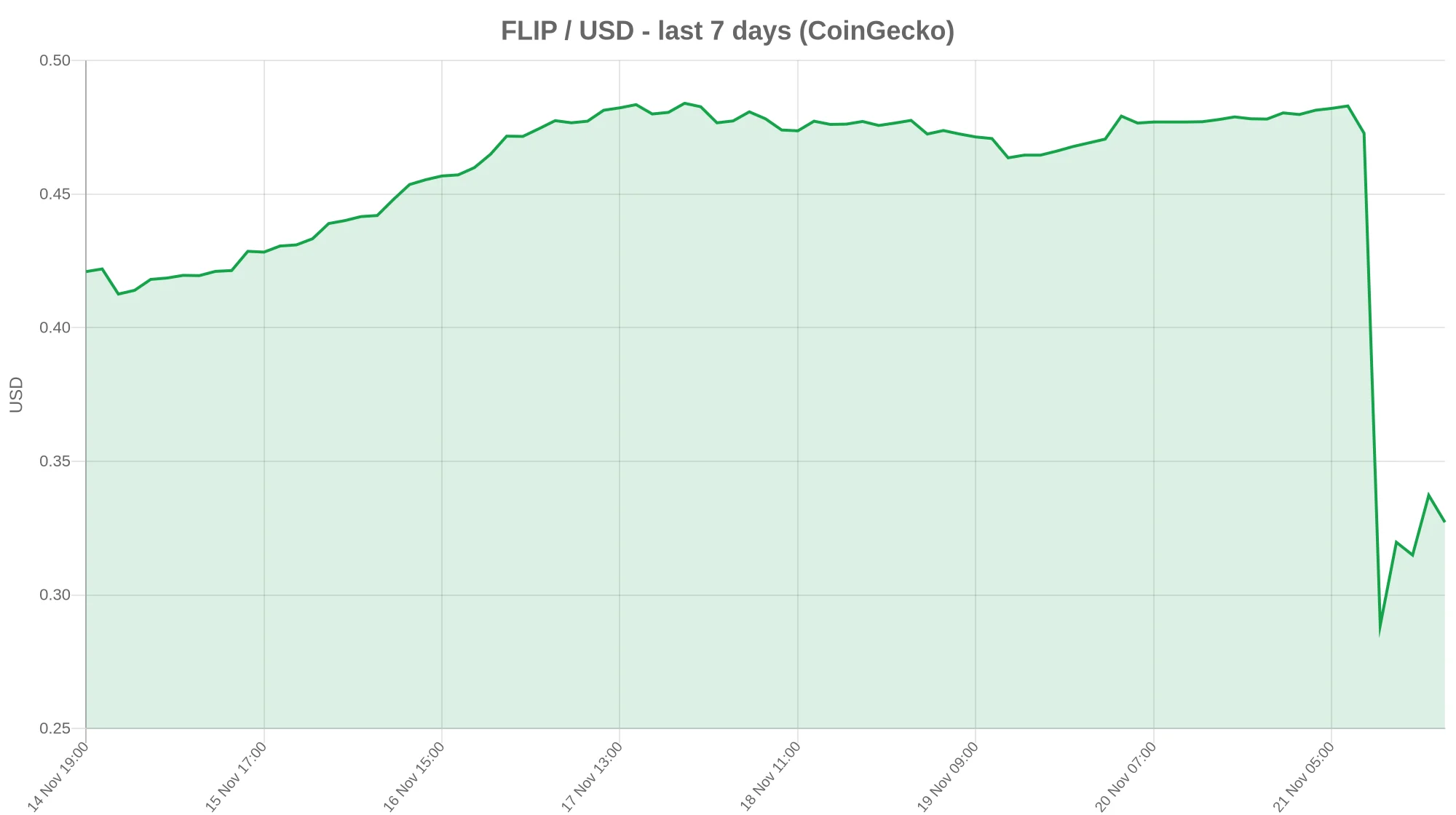
Two readings are available and the evidence supports only one of them strongly. The first is that the market needed time to understand what had happened, which is common when a protocol publishes nothing and traders rely on tracker accounts. The second is that the sale was driven by something other than the drain, because a rational holder watching a $4.88 million hole open at 07:10 had an hour of unchanged prices in which to sell.
What can be stated without hedging is the divergence. Bitcoin rose 1.79% and Ether rose 3.34% over the same 24 hours, so FLIP’s 31.7% decline was not market beta. The token lost roughly $13 million of market value in a day while the two largest assets gained. Whether the trigger was the drain, the silence, or the realisation that the protocol’s own treasury cannot cover a loss of this size is a question the price data cannot settle.
What Chainflip has said: one banner, no post
As of 18:30 UTC, Chainflip’s site carried a repeating banner across the top of every page: “Chainflip services are temporarily unavailable.” The second line sends readers elsewhere: “Head to our discord for more updates.” The blog index shows posts dated Nov. 21 and Nov. 20, both about swap routes, and nothing about the vault.
The contrast with August is sharp, and the team set it itself. After the earlier incident it published a post titled An update on the recent network incident, which said: “The response worked as intended: we were able to pause quickly, protect funds, and ship a fix in short order.” It also promised more detail later, and it closed the loop: “We’ll publish more details on the specifics of what happened in the coming weeks.”
Nothing comparable exists for Nov. 21 yet. That absence is itself a fact readers can act on, and it cuts both ways. A team that has not published a statement may still be mid-investigation, which is the responsible order of operations when a signing key is in question. A team that has not published a statement also has not told liquidity providers whether the loss is socialised, reimbursed, or absorbed by a surplus that, by crypto.news’ account of the September proposal, amounted to just over $1.08 million in USDC.
What is left inside the vault
The vault is not empty, but it is close to it in dollar terms. At 18:00 UTC the contract held 8.6643 ETH, 756,429.93 FLIP, 10,816.04 USDT and 4,342.79 USDC. Priced at the same CoinGecko snapshot, that is roughly $277,000, of which about $247,000 is FLIP, the protocol’s own token. The liquid assets a liquidity provider would want to see are gone.
The September precedent is the closest thing to a playbook. Chainflip lost 736,442 USDT on Tron on Sept. 12 after its integration paid six withdrawals twice, as BR reported at the time. Validators then approved Proposal 008, which returned whatever the vault could recover and credited affected liquidity providers with USDC at a one-to-one rate for the remainder. Today’s loss is 6.6 times that one, and the surplus that covered it no longer exists.
That arithmetic is the reason the next governance vote matters more than the next patch. A reimbursement at today’s size cannot come from the vault’s remaining balance. It would have to come from the treasury, from a validator assessment, or from the reserve the Crosschain Association proposed in September, when it suggested setting aside 10% of broker fee revenue for future claims. A 10% reserve builds slowly. It does not answer a $4.88 million hole that opened in one block.
The governance question the code cannot answer
Three things are unresolved, and each has a different owner. The first is the key. If the aggregate signing key is compromised at the share level, rotating it is not a code change; it is a ceremony that requires the validator set to agree on a new key and every chain integration to accept it. That work has not been announced.
The second is the pause. The site says services are unavailable, which covers swaps broadly, and the on-chain record shows the vault still processing allBatch egress calls after the drain, including batches at 08:17 and 10:00 UTC. Readers should not assume those later batches were unauthorised; they may be the protocol paying out swaps that were already in flight. But the gap between “services unavailable” and a vault still signing batches is exactly the kind of detail a public incident report exists to explain.
The third is disclosure. Chainflip’s docs describe a 100-of-150 signing design built so that no small group can move funds alone. Either that threshold held and a large share of the validator set signed a batch it should not have, or shares were combined outside the ceremony the design assumes. Until the team says which, every liquidity provider on the protocol is being asked to price a risk it cannot see.
For traders, the practical read is narrow. FLIP at $0.327 is a bet on a reimbursement decision, not on a swap product, because the swap product is offline and the vault that backs it holds under $300,000. For the protocol, the test is whether the next public statement is a post-mortem with a key-rotation plan and a claims process, or another banner.
This article is not investment advice. Figures are taken from on-chain records and public statements reviewed at the time of publication, and developing incidents can change after publication.
Data: Blockscout, CoinGecko, Chainflip.
This story was originally published by Blockchain Reporter. Read the original article.