Bitcoin Slides to Six-Week Low Below $77K as Binance Halts Withdrawals and Vows to Cover Losses

Bitcoin slipped through $77,000 in the early hours of October 30 and kept sliding, settling near its lowest level in six weeks after the fallout from a record Binance hot-wallet hack forced the world’s largest exchange to close its on-chain doors in both directions. The leading cryptocurrency traded near $76,600 on Binance, down roughly 4% over 24 hours, after the exchange said it was suspending all deposits and withdrawals while it froze funds, coordinated with law enforcement, and pledged to cover every dollar lost.
The slide came hours after an attacker drained Binance 14, one of the exchange’s most active Ethereum hot wallets, of about $2.5 billion in a single transaction — a figure that has since climbed as security firms and the exchange itself tallied the damage. Ethereum, Solana, and Binance’s own BNB token all fell harder than Bitcoin, a sign the fear was broad rather than Bitcoin-specific.
We are working non-stop to resolve this issue. Binance will cover all losses. As a precaution, all deposits and withdrawals are temporarily suspended while our team conducts security checks, freezes funds, and works with law enforcement.
— Binance (@binance) October 30, 2026
A Full Freeze, Not a Pause
The statement above, posted at 00:13 UTC, marked a sharp escalation from the cautious tone Binance struck in its first public comment. That earlier message said only that the exchange was “aware of reports of a possible security issue” and had “not confirmed that user funds have been affected.” Within minutes the company had hardened the line to “user funds are completely safe,” and by the early morning it was freezing the entire platform.
Binance paused withdrawals on multiple networks at 22:15 UTC on October 29, then suspended deposits and Binance Alpha trading over the following hours. The full freeze, announced in the post above, came with the exchange’s first official tally: $2.54 billion in assets frozen, “and this figure may continue to increase.” By the morning of October 30 the verified frozen total had risen to $3 billion, according to updates the company posted on its official account.
Co-founder Changpeng Zhao, who no longer runs the company but remains its largest shareholder, put the outcome in plainer terms. “User funds are safe! It does look like a hack on Binance,” Zhao wrote on X, thanking Tether and Circle for freezing roughly $971 million and $823 million respectively. Asked about a loss estimate that ran to about $1 billion after the freezes, he replied: “Loss might be a bit higher than that, but will cover.”
The Delegation That Emptied Binance 14
The on-chain trail is what turned a routine-looking wallet shuffle into a full-blown incident. At 20:24 UTC on October 29, Binance 14 sent 167,464 ETH — worth about $388 million — plus 63 other tokens, including roughly $1.6 billion in Tether (USDT), to an address that had not existed before that evening. Twenty-four seconds later a second wallet, Binance 16, moved another 28,005 ETH to the same destination. BlockchainReporter’s earlier report on the outflow walks through the full sequence.
Security firm Blockaid traced the mechanism to EIP-7702, an Ethereum feature that lets an ordinary wallet temporarily hand control to a smart contract. At 20:20:59 UTC a wallet funded only through the Tornado Cash mixer installed a signed delegation on Binance 14, and four minutes later the attacker’s contract swept the wallet clean in a single call. Setting that delegation requires a signature from Binance 14’s own key, which is why investigators describe the event as a key compromise rather than a protocol bug.
Tether and Circle moved quickly to cap the damage. Tether froze $975 million in USDT in the main collection address, a figure CEO Paolo Ardoino later put above $1.5 billion, while Circle froze $823 million in USDC. “Circle is closely tracking reports of a potential exploit involving Binance,” CEO Jeremy Allaire wrote on X. “In coordination with law enforcement, we have frozen more than 800M USDC associated with the incident and will continue supporting the investigation.”
Fear Drove the Slide, Not Forced Selling
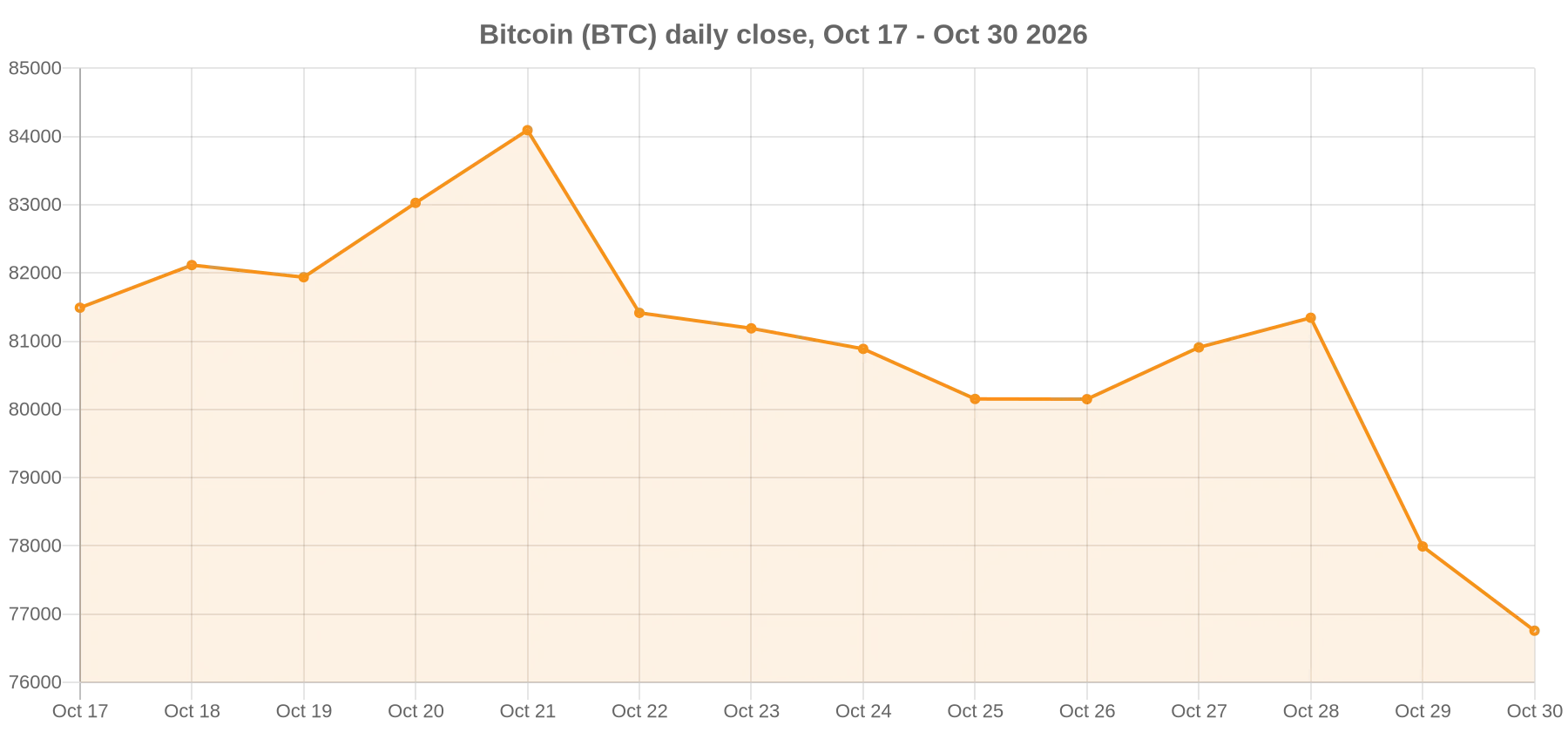
The market’s reaction was fast and lopsided. Bitcoin fell about 4% over 24 hours to trade near $76,600, according to Binance market data, after trading as high as $81,971 earlier in the session. Ether dropped 5.2% to near $2,195, Solana shed 5.9% to about $94, and BNB — the token of the exchange at the center of the story — lost 5.6% to near $704.
The scale of the numbers helps explain why this was a sentiment event rather than forced liquidation. Bitcoin’s market capitalization, roughly $1.5 trillion, dwarfs even the $2.5 billion to $3 billion in stolen funds — the drain represents about 0.2% of the network’s value. A theft that size does not mechanically move the price. It moved the market because it renewed a very old fear: that the largest venue in crypto can be breached, and that no custodian is fully safe.
The six-week low is real, not rhetorical. Bitcoin’s intraday low near $76,650 is its lowest print since September 18, when it briefly touched $76,296. The token has now surrendered a seven-day gain and is down about 5.5% over the past week, closing a stretch in which it had held above $80,000 for most of late October.
The Levels Traders Are Watching
Bitcoin is now trading well below its 24-hour volume-weighted average price near $79,380 and its seven-day simple moving average near $79,750, a sign the move lower is broad-based rather than a thin-book wick. The first support zone sits at the October 30 low of $76,650, with the September 18 floor of $76,296 as the next line beneath it. A daily close below $76,300 would open the door to the mid-September range and mark the first clean break of the past six weeks.
On the upside, $78,000 is the first level the market has to reclaim. It acted as support through late October before the freeze, so it now reads as overhead supply. Above that, the 24-hour high of $81,971 and the $80,035 level where the 24-hour session opened are the resistance points that would need to fall for the trend to turn convincingly. These levels are derived from Binance’s public price feed for the trailing 24 hours and the daily candles of the past six weeks, not from a forecast model.
What the Selloff Does Not Prove
The decline coincided with the Binance freeze, but a coincidence is not a proven cause. Spot selling, leveraged liquidations, and a broader risk-off mood can all press a market lower at the same time, and available data does not isolate how much of the drop was Binance-specific versus a general flight from risk. The token’s harder fall relative to Bitcoin is the strongest evidence that the exchange itself was the catalyst, but it is still circumstantial.
The freeze also arrived hours after a separate incident at Polymarket, which paused trading after a third-party vendor breach. Two exchange-side security events landing within a single evening compressed the market’s mood, and both are still being investigated. Binance has not published a technical post-mortem, and the final loss figure is not settled while freezes and recoveries are still being tallied.
What to Watch Next
The next concrete signal is Binance’s proof-of-reserves snapshot, due November 1. It will show whether the exchange has backfilled the drained hot wallets from its cold reserves and how much of the $2.54 billion to $3 billion in frozen assets can be recovered. A second signal is the resumption of withdrawals: Binance has said it will reopen them “as soon as the security issue is fully resolved,” without a timeline, and any delay beyond a few days would itself become a story about counterparty risk.
The Arbitrum Security Council has already executed an emergency freeze of $30.5 million tied to the exploit, involving 74.6 million ARB and 8,425 ETH, and moved the funds to an intermediary wallet controlled by governance. Other chains and issuers may follow as investigators map the roughly 20 wallets the attacker has used to spread the proceeds. Until Binance releases its post-mortem, the safest framing is what the exchange itself has said: user funds are safe, all losses will be covered, and the investigation is ongoing.
Frequently Asked Questions
Is my money safe on Binance?
Binance has said user funds are safe and that it will cover all losses, and co-founder Changpeng Zhao said he expects all user funds to be fully covered. Withdrawals remain temporarily suspended while the exchange completes security checks.
How much was stolen in the Binance hack?
The first transaction drained about $2.5 billion, and Binance has confirmed $2.54 billion frozen, later rising to $3 billion. Security firm Blockaid tallied roughly $5.5 billion across Ethereum, Bitcoin, Tron, and other chains, which would make it the largest crypto theft on record.
Why did Bitcoin fall below $77,000?
Bitcoin dropped about 4% in 24 hours to a six-week low as the Binance hot-wallet hack and the full suspension of deposits and withdrawals shook confidence across crypto. Ether, Solana, and BNB fell even harder.
When will Binance withdrawals resume?
Binance has not given a timeline, saying only that withdrawals will resume once the security issue is fully resolved. The company has promised a full post-mortem when its investigation is complete.
This story was originally published by Blockchain Reporter. Read the original article.