Best Crypto to Buy Now: Bitcoin Whipsaws Near $69K While NEAR and Stellar Climb

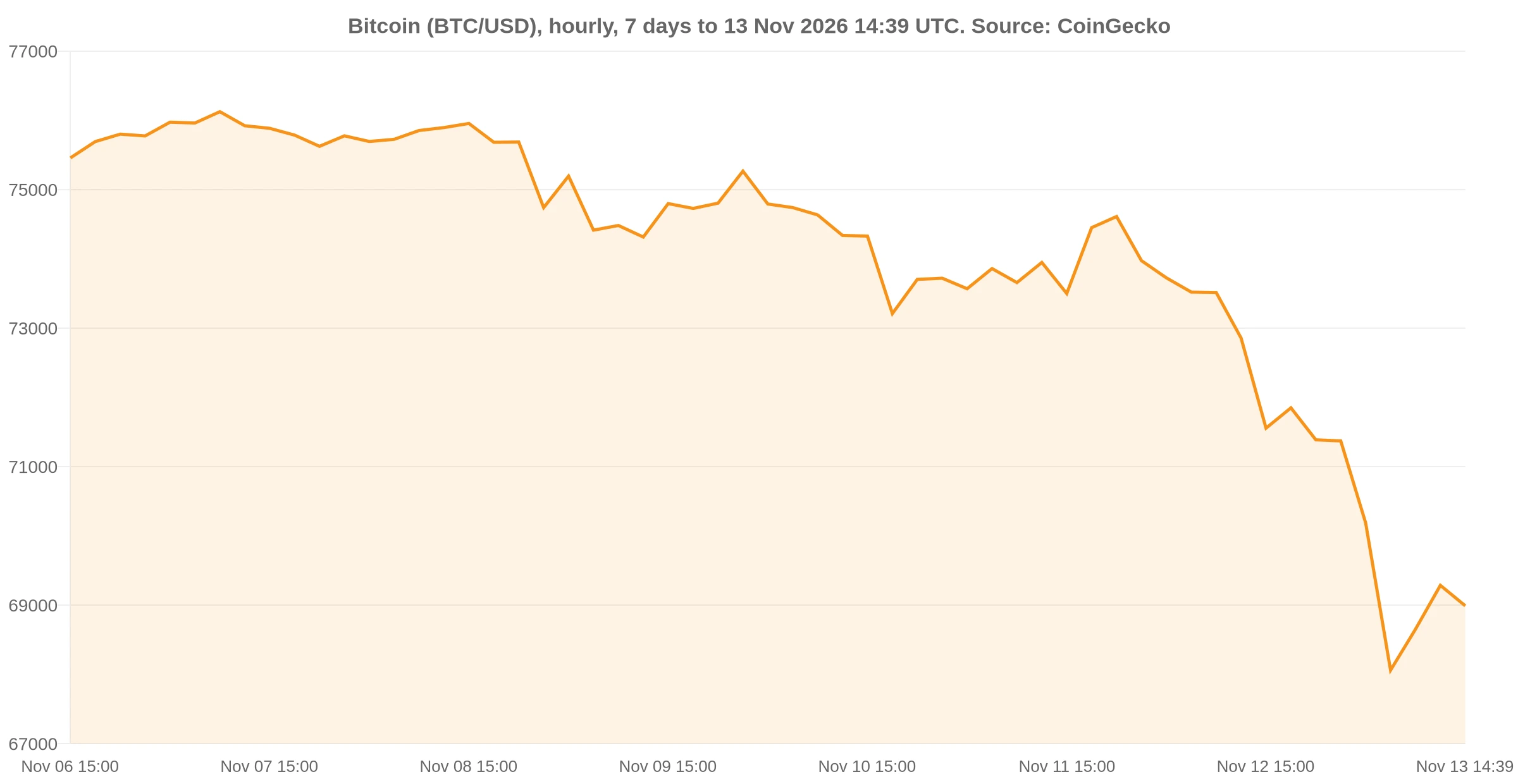
At 06:00 UTC the Bitcoin candle on CoinGecko’s hourly series printed $68,061.87, the first time the price had traded under $69,000 since Aug. 19. By 14:45 UTC the largest crypto asset had clawed back to $68,900, down 4.31% over 24 hours, while the median return across the twenty largest non-stablecoin tokens was positive 1.22%. That gap is the whole story of the session, and it is the reason the answer to “best crypto to buy now” is not one name this afternoon.
The tape says Bitcoin is the asset being sold. The green list is short and, in two cases, has a dated paper trail behind it: NEAR at $3.56, up 4.56%, after its Intents product went live inside Talos’ order management system on Nov. 9, and Stellar’s XLM at $0.1491, up 3.59%, as tokenized-asset demand keeps finding that network. Everything below is the evidence for that split, the arithmetic behind it, and the specific conditions that would prove the read wrong. Prices are CoinGecko quotes at 14:45 UTC on Nov. 13 and will move.
Six sessions, $1.72 billion, and one fund carrying most of it
The cleanest explanation for why Bitcoin is the weak leg sits in the spot ETF ledger, not in a chart. Farside Investors’ flow table shows six consecutive sessions of net redemptions from the US spot Bitcoin funds, beginning Nov. 5 and running through Nov. 12. The daily totals were negative $430.2 million, negative $411.9 million, negative $201.0 million, negative $95.0 million, negative $299.8 million and negative $284.1 million.
Add those six figures and the cumulative six-session total is negative $1,722.0 million, or roughly $1.72 billion withdrawn from the category in six trading days. That sum is not printed on the tracker; it is the arithmetic of its own daily column, and it matters because it converts a vague phrase like “ETF selling” into a number a reader can hold next to the market cap.
One fund did most of it. BlackRock’s IBIT accounts for negative $1,272.9 million of the six-session total, or 73.9% of every dollar that left the group. On Nov. 12 alone, IBIT redeemed $203.8 million of the $284.1 million total, which is 71.7% of that session’s outflow.
The full Nov. 12 row is worth reading in one piece, because the shape of the exit is as informative as the size. IBIT lost $203.8 million, Fidelity’s FBTC lost $32.6 million, Bitwise’s BITB lost $26.4 million, ARKB lost $18.5 million, HODL lost $6.1 million, and Morgan Stanley’s MSBT was the single fund to take in money at positive $3.3 million. BTCO, EZBC, BRRR, BTCW, GBTC and the Bitwise BTC fund all recorded zero. Nov. 13’s column was still unpublished when this article was written, so the streak has no confirmed seventh session.
Two readings are possible and they are not equally supported. The first is that allocators are trimming a position that has fallen from $76,124.97 on Nov. 7 to $68,061.87 this morning. The second is that a small number of large tickets went through one issuer’s door in a thin week. What the ledger proves is the direction and the size. What it does not prove is intent, and this article will not pretend otherwise. For the price action that followed the flows, see our report on Bitcoin’s break below its 200-day average.
Why the damage stopped at Bitcoin’s door
Bitcoin’s market value is $1.386 trillion, or 58.86% of the $2.344 trillion that CoinGecko counts across every crypto asset. A 4.31% move on an asset that size removes roughly $60 billion of value. The same percentage on Solana’s $47.89 billion removes about $2 billion. There is no mechanical reason the smaller assets had to follow, and this afternoon they did not.
The distribution is unusually tidy. XRP held at $1.029, effectively flat. Dogecoin added 0.73%, Cardano 1.82%, Litecoin 1.41%, Avalanche 1.70%, Sui 3.11%, Chainlink 1.37%. NEAR led the group at 4.56% and Hyperliquid followed at 4.02%. The two assets that spent the day red were Bitcoin and Ethereum, and Ethereum’s 2.60% decline came after a 11.72% seven-day slide from $2,226 to $1,956 that had already taken it under $2,000 and to a session low of $1,909.25 at 06:00 UTC.
That sequencing is the part worth keeping. The alts fell first and fell harder: NEAR’s low of the week, $3.2696, was printed at 05:00 UTC this morning, which is 9.38% below the current price and 13.6% below its Nov. 11 high of $3.7853. What happened after 06:00 was not altcoin strength arriving out of nowhere. It was a bounce in assets that had already been marked down while Bitcoin was still working through its own supply.
NEAR’s green candle has a paper trail
The NEAR bid has something most green candles this week do not: an announcement with a date, a named counterparty and two executives willing to be quoted. On Nov. 9, the NEAR team published that NEAR Intents is now live inside Talos’ Order and Execution Management System. Talos supplies trading infrastructure to asset managers, hedge funds, ETF issuers and banks, and the integration lets those clients source cross-chain liquidity through the same order and execution workflow they already use for every other venue.
Alex Shevchenko, chief executive of Defuse Labs, which develops NEAR Intents, framed the product in exactly those terms:
“This is what institutional access to DeFi should look like: existing custody integrations, no new workflow, and competitive cross-chain pricing on every order. Talos connects some of the largest trading desks in digital assets. NEAR Intents is now the route that brings their flow onchain, into the markets and liquidity the rest of DeFi runs on.”
Daniel Packham, Talos’ vice president and head of provider network, described the demand from the other side of the trade:
“Talos clients asked for access to solver-sourced liquidity without standing up a second operating model to reach it. Competitive quoting is becoming a real source of institutional liquidity, and it now reaches clients through the same Talos request-for-quote workflow they use for spot blocks, options and ETF creations/redemptions.”
The numbers in the announcement are specific enough to check against later filings and dashboards. NEAR says Intents has processed more than $37 billion in total volume and more than $4 billion in the past 30 days, with swaps typically settling in under a second and network fees under a cent, drawing liquidity from more than 30 chains plus centralized venues. Fungible tokens are supported today; tokenized real-world assets, yield-bearing assets and prediction markets are described as next, which is the part that would matter to an institution that already trades those instruments elsewhere.
Nothing in that document says the integration moved NEAR’s price today. The product went live on Nov. 9, four sessions before this candle, and a single day’s move is not evidence of cause. What the announcement does is give the asset a reason to be looked at on a day when the largest token is being redeemed, and it puts a number on the flow: $4 billion in 30 days is roughly $133 million a day of cross-chain volume running through a system whose fees accrue to its stakeholders. The same institutional logic is now visible elsewhere in crypto, from DTCC’s plan to put DTC-tokenized securities on Solana in 2027 to the tokenized-stock venues that have launched this month.
What $1,000 buys at 14:45 UTC
Market-cap arithmetic is the only honest way to compare assets at different prices, because a $1 token and a $68,900 token are the same thing once you own the same dollar amount of market value. The table below uses CoinGecko’s circulating supply, so the market-cap figures are the tracker’s, not a projection.
| Asset | Price at 14:45 UTC | 24h change | $1,000 buys | Market cap at 2x |
|---|---|---|---|---|
| Bitcoin | $68,900 | -4.31% | 0.01451 BTC | $2.771 trillion |
| Ethereum | $1,956.49 | -2.60% | 0.5111 ETH | $478.22 billion |
| Solana | $80.99 | -0.44% | 12.35 SOL | $95.78 billion |
| Chainlink | $10.05 | +1.37% | 99.5 LINK | $15.42 billion |
| NEAR | $3.56 | +4.56% | 280.9 NEAR | $9.36 billion |
| Stellar | $0.1491 | +3.59% | 6,707 XLM | $10.56 billion |
Read the last column slowly, because it is where most retail crypto arithmetic goes wrong. A 2x on NEAR requires $4.68 billion of net new money to buy a $9.36 billion asset. A 2x on Bitcoin requires $1.386 trillion of new money to buy a $2.771 trillion asset. The percentage gain is identical; the capital that has to show up is 296 times larger. For Bitcoin to reach $100,000 from here it needs a 45.14% advance and a market cap of $2.011 trillion, which is 85.8% of everything the crypto market is worth this afternoon.
The same arithmetic caps the fantasy on the other side. NEAR at ten times today’s price would be $35.60 and a $46.8 billion market cap, which is roughly the size Solana carries today at $47.89 billion. That is not impossible. It is also not a small ask: it would make NEAR the sixth-largest non-stablecoin asset in the market, behind Bitcoin, Ethereum, BNB, XRP and Solana.
The part of this trade that can break
Altcoin green on a Bitcoin red day has a poor record of persistence, and there are three specific reasons to discount this one.
First, breadth is thin. The move is concentrated in mid-caps that had already been sold hard: NEAR is still 5.52% below its Nov. 11 high, Stellar is 4.67% below its Nov. 6 high of $0.1564, and Ethereum is 11.72% lower over seven days. A bounce inside a downtrend is not a rotation, and the difference between the two shows up over weeks, not hours.
Second, dominance has not cracked. Bitcoin still holds 58.86% of the $2.344 trillion market, and the total market cap is down 5.76% in 24 hours, a larger decline than Bitcoin’s own, so Bitcoin’s share of a shrinking pie is roughly stable. A rotation shows up in that share falling across several sessions. One green afternoon in mid-caps does not move it. If allocators keep redeeming IBIT and FBTC, the next leg of selling arrives in the same assets that are green this afternoon, because the funds’ redemption mechanism does not distinguish between a good week for NEAR and a bad one for Bitcoin.
Third, the flow data is one-sided by design. Farside’s table measures the US spot Bitcoin funds. There is no comparable daily redemption vehicle for NEAR or Stellar, so their green candles are the product of spot order books with far less daily volume. That makes them easier to move up and easier to move down.
None of that makes the NEAR announcement less real. It makes the price follow-through unproven, which is a different claim.
The levels that decide whether the read survives
Three prices carry the argument, and each has a stated basis rather than a round number someone liked.
Bitcoin $68,061.87. That is the low of the seven-day hourly series, set at 06:00 UTC on Nov. 13. A close below it on the daily chart, with the ETF column still printing redemptions, ends the “Bitcoin-specific, contained” reading and turns the whole market into a single trade again. The neutraliser is $72,430, the price 24 hours ago: a reclaim of that level would say the redemption wave found a bid without help from the alts.
NEAR $3.2696. The low of the week, printed at 05:00 UTC today. The case for NEAR rests on the product having changed its flow profile; if the price loses the level it held before the bounce, the market is saying the Talos integration did not change anything that trades. Upside confirmation would be a close above $3.7853, the Nov. 11 high.
Ethereum $1,909.25. The session low and the low of the seven-day window, set at 06:00 UTC. Ethereum is the tell for whether this is a Bitcoin-only event or a market-wide de-risking: it has already lost 11.72% in a week and trades at $1,956.49. If ETH breaks its morning low while Bitcoin holds above $68,061, the divergence thesis is dead and the correct description becomes a broad drawdown with a Bitcoin-specific first leg.
What would confirm the read is narrower and less exciting than a rally: two consecutive sessions in which Farside’s Bitcoin column prints an inflow while NEAR and Stellar hold their morning lows. That would mean the redemption pressure stopped without the alt bid reversing, which is the only combination that historically precedes a real rotation.
Frequently Asked Questions
What is the best crypto to buy right now?
There is no single answer, and this article is not investment advice. At 14:45 UTC on Nov. 13, Bitcoin traded at $68,900 after a 4.31% decline, while the median of the twenty largest non-stablecoin tokens was up 1.22%. The two names with a dated catalyst were NEAR at $3.56, after its Intents product went live in Talos’ order management system on Nov. 9, and Stellar at $0.1491.
Why is Bitcoin falling while altcoins rise?
The measurable difference is supply. US spot Bitcoin ETFs recorded net redemptions in six consecutive sessions through Nov. 12, totalling negative $1,722.0 million per Farside Investors’ daily column, with BlackRock’s IBIT responsible for negative $1,272.9 million of that. There is no comparable daily redemption vehicle for NEAR or Stellar, so their order books did not absorb the same mechanical selling. The alts had also fallen first: NEAR’s weekly low came at 05:00 UTC, before Bitcoin’s low at 06:00 UTC.
How much would Bitcoin need to gain to reach $100,000?
From $68,900, Bitcoin needs a 45.14% advance to reach $100,000. Because supply is fixed, the market cap would rise from $1.386 trillion to $2.011 trillion, which requires that much net new money to enter the asset.
What is NEAR Intents?
NEAR Intents is a cross-chain execution system that does not run a liquidity pool. A user states the outcome they want, and competing professional counterparties called solvers bid to fill the order, sourcing liquidity across more than 30 chains plus centralized venues. NEAR says the system has processed more than $37 billion in total volume and more than $4 billion in the past 30 days, with swaps typically settling in under a second.
Is this the start of altcoin season?
The data does not support that claim yet. Bitcoin still holds 58.86% of a $2.344 trillion market, and the total market cap fell 5.76% in 24 hours, a larger decline than Bitcoin’s own, so its share of the market is roughly stable. A rotation would show up as falling Bitcoin dominance across several sessions, not as one green afternoon in mid-caps that are still below their weekly highs.
Data: Farside Investors, CoinGecko. Announcement: NEAR and Talos. All prices are CoinGecko quotes at 14:45 UTC on Nov. 13, 2026 and will change.
This article is not intended as financial advice. Educational purposes only. Prices cited are CoinGecko quotes taken at 14:45 UTC on November 13, 2026 and will change.
This story was originally published by Blockchain Reporter. Read the original article.