Baillie Gifford Chooses Ethereum to Track Legal Ownership of UK Fund
TL,DR:
- British asset manager Baillie Gifford implemented the Ethereum and Solana network as the official legal ownership registry for the Baillie Gifford Enhanced Yield Fund (BAGEY).
- The fund, structured as an Open-Ended Investment Company (OEIC) regulated in the United Kingdom, focuses on a portfolio of short-duration corporate bonds.
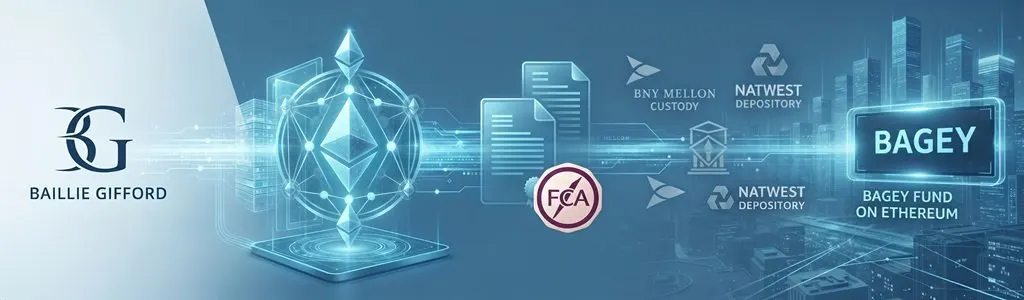
- The tokenization and institutional wallet management infrastructure is backed by BNY Mellon, while NatWest acts as the supervising depositary.
British asset manager Baillie Gifford has taken a monumental step in the institutional adoption of distributed ledger technology by incorporating the Ethereum network as the legal basis for tracking ownership of its enhanced yield fund, known under the ticker BAGEY.
A $260 BILLION ASSET MANAGER IS USING ETHEREUM AS AN OFFICIAL LEGAL REGISTER
“We've now sort of promoted Ethereum to be an official source of records for ownership of regulated funds in the UK.”
Ian Wallis of Baillie Gifford, founded in 1908, explains the milestone achieved… pic.twitter.com/9D30XVyOpE
— BMNR Bullz (@BMNRBullz) November 13, 2026
Recent industry reports indicate that this implementation differs from traditional “wrapped” financial products, where the digital asset functions merely as a parallel representation of an external physical registry. Under the scheme adopted by the Edinburgh-based firm, the tokens issued on the blockchain directly constitute legal ownership in the fund.
Data from the creators of the initiative indicate that the structure seeks to simplify intermediated transfer and settlement processes. By using the decentralized network as the primary source of legal truth, subscription and redemption operations can be executed with greater speed through the use of stablecoins like USDC, reducing the times associated with conventional settlement mechanisms.
Regulated Infrastructure and Institutional Collaboration
The development of this investment vehicle has required close coordination with United Kingdom regulatory authorities. The fund operates under the authorization of the Financial Conduct Authority (FCA), integrating within the current regulatory parameters for open-ended investment funds.
Meanwhile, industry reports highlight the participation of large-scale banking entities in technical and operational support. BNY Mellon provides the necessary infrastructure for custody and institutional digital wallet management, while NatWest Trustee and Depositary Services assumes supervisory functions as depositary. This hybrid architecture allows professional and institutional investors to operate under the compliance standards required in jurisdictions such as the United Kingdom, Switzerland, and the Cayman Islands.
Perspectives on Asset Tokenization
Spokespersons for the financial institution have indicated that the adoption of public networks like Ethereum responds to a natural evolution in capital market infrastructure. However, financial market analysts recall that while on-chain technology provides traceability and operational transparency, the underlying portfolio composed of corporate bonds and short-duration fixed-income instruments inherently maintains the usual credit and interest rate fluctuation risks inherent to the debt market.
The evolution of this decentralized registry will continue under British regulatory supervision, setting a precedent for how traditional financial institutions can interact directly with public blockchain networks to manage the ownership of regulated assets.
This story was originally published by Crypto Economy. Read the original article.