ApeChain Switches From LayerZero to Chainlink for Cross-Chain Transfers
TL;DR:
- Infrastructure replacement: ApeChain replaces LayerZero’s solution with Chainlink CCIP as its canonical cross-chain interoperability standard.
- Asset upgrades: APE, USDC, and other core tokens will migrate to Chainlink’s Cross-Chain Token (CCT) standard.
- No public timeline: Initial releases from Chainlink and ApeCoin omit sunset deadlines for the prior bridge and user swap procedures.
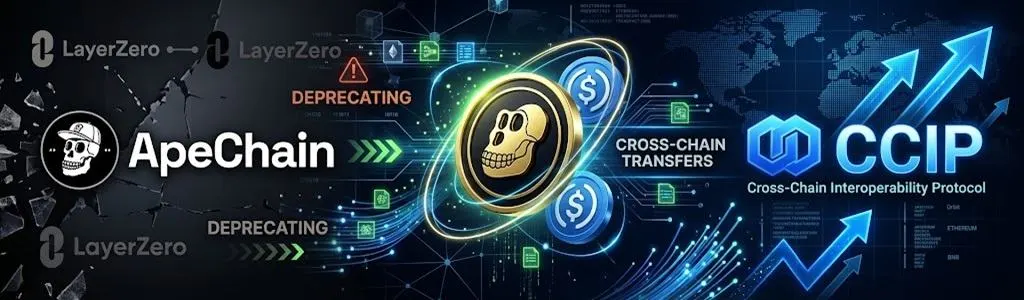
The ApeChain network switched from LayerZero to Chainlink. This shift took place after officially adopting its Cross-Chain Interoperability Protocol (CCIP) as the canonical architecture for asset transfers across the entire Yuga Labs ecosystem.
NEW: ApeChain is deprecating its legacy cross-chain solution & migrating to Chainlink CCIP.
CCIP is now becoming the canonical cross-chain infra across the entire Yuga Labs ecosystem, starting with its flagship @BoredApeYC use cases, ApeChain, & the APE token.
Two communities.… https://t.co/R9msnkI1Ro pic.twitter.com/UE1xDbcvVY
— Chainlink (@chainlink) November 4, 2026
The transition covers both the interoperable messaging layer and the technical standards governing capital movements. Chainlink’s official account reported this Wednesday that the previous solution is entering technical deprecation. Meanwhile, the ApeCoin organization confirmed the migration will span flagship Bored Ape Yacht Club use cases, ApeChain-native applications, and the APE token.
Technically built as a Layer 3 network on Arbitrum Orbit, ApeChain utilizes the APE token as its native asset to settle gas fees. The existing architecture operated via the Omnichain Fungible Token (OFT) standard provided by LayerZero. Under that prior setup, cross-chain transfers burned or debited tokens on the source network and credited an equivalent amount on the destination chain, maintaining a unified supply across Ethereum, Arbitrum, Solana, HyperEVM, BNB Chain, Monad, and Robinhood.
Market data notes that neither ApeCoin nor Chainlink attributed the pivot to specific security breaches or detected smart contract vulnerabilities within ApeChain. Institutional statements framed the integration as a move to streamline operational connectivity across decentralized applications, communities, and digital assets.
Migration to the CCT Standard and Transfer Mechanisms
Under this framework, APE and USDC assets will transition to Chainlink’s Cross-Chain Token (CCT) format. Protocol documentation specifies that this model empowers developers to register ERC-20 tokens within the CCIP network while retaining direct governance over token contracts, liquidity pools, and per-lane transfer limits.
Chainlink’s architecture functions via configurable token pools supporting various mechanisms, such as burn-and-mint flows, lock-and-mint setups, or liquidity-backed disbursements on destination chains. The notice released by ApeCoin did not specify the exact operational model assigned to APE or USDC.
Technical CCIP documentation indicates that bridge aggregators and external dApps can interface with the router without deploying custom contracts for every token. An internal registry maps the token address to its pool and admin, directing execution to the appropriate logic without escrowing custody inside the registry itself.
Operationally, CCIP fees are determined by source and destination networks, destination gas costs, message payload size, and selected verification layers. Final costs may incorporate protocol fees, network execution charges, and custom pool fees configured by administrators. Statements issued on November 4, 2026, did not include an itemized rate structure for ApeChain or LINK staking mandates for APE holders.
Industry reporting frames this transition within a broader series of bridge migrations toward the oracle network. The Ronin network completed its infrastructure migration in April 2025, migrating over $450 million in assets to CCIP. Similarly, Bitcoin liquidity protocol Lombard transitioned more than $1 billion in BTC-linked assets in May 2026 following an internal risk assessment, while Mantle concluded the migration of its ~$2.5 billion Super Portal bridge in July 2026.
As of publication time, the involved entities have not disclosed a deprecation deadline for the LayerZero-powered bridge, nor clarified whether holders must complete manual token swaps or if balances will update automatically through proxy contracts.
This story was originally published by Crypto Economy. Read the original article.