Aave Labs Acquires Avon to Add Fixed-Rate Lending to Onchain Credit
Aave Labs bought Avon on 6 November 2026, acquiring the team and the technology behind one of the few groups building fixed-rate lending markets onchain. The transaction brings Avon founder Prince Sinha, engineer Ayush Kaul and business-development lead Omar el-Ashaal into Aave Labs, along with Avon’s fixed-rate and floating-rate lending protocols, its purpose-built onchain order book and its domains. The company announcement states no purchase price, no closing conditions and no launch date.
That omission matters because Aave is already the largest onchain lending network, with more than $33 billion in deposits and more than $13 billion in active loans according to the same post. Every one of those loans prices at a floating rate set by the utilisation curve of its reserve. A fixed rate is a different instrument: the borrower locks a coupon for a term, and a lender gives up the right to leave at will in exchange for a known yield.
The Deal Adds Three People and a Codebase, Not a Live Market
The list of what changed hands is short and specific. Aave Labs acquired Avon’s technology, defined in the post as its fixed-rate and floating-rate lending protocols and its onchain order book, plus Avon’s domains and related assets. The three named hires carry the operating knowledge: Sinha and Kaul join the engineering team, el-Ashaal joins business development. The post says the Avon team will continue developing this technology inside the Aave ecosystem under Aave Labs.
What the announcement does not describe is a product. It does not say which chain a fixed-rate market would run on, which collateral would be eligible, what maturities would be offered, or when any of it would reach users. “Aave’s goal is to bring the best of finance to everyone, and that means offering the kinds of products users already rely on, including fixed rates,” said Stani Kulechov, founder and CEO of Aave Labs. The sentence sets a direction; it does not set a date.
Sinha’s quote is framed the same way, as a continuation rather than a delivery. “We started Avon to bring the depth of global credit markets onchain, and Aave is the best place to continue that work, where it can reach institutions, fintechs, and everyday users at scale,” he said. Read together, the two statements describe hiring a team that has worked on interest-rate pricing and risk isolation, not switching on a market.
Why a Fixed Rate Needs an Order Book
Aave’s core markets do not set rates by negotiation. Each reserve has a utilisation curve: as borrowed liquidity rises against what is available, the borrow rate climbs to pull in deposits and push out borrowers, and as repayments arrive the rate falls again. The mechanism is efficient and it is transparent, and it leaves both sides exposed to the rate moving after the loan is drawn.
A fixed rate cannot be produced by that curve alone. Someone has to commit capital for a defined period at a defined price, and someone else has to accept that price for the same period. That matching is what an order book does. The post describes Avon’s work as spanning interest-rate pricing, risk isolation and markets designed to support more sophisticated credit products, which is the right vocabulary for a term-lending venue rather than a pool.
Liquidation is the second problem. A floating-rate loan is monitored against collateral value and an interest accrual that adjusts with utilisation. A fixed-rate loan with a maturity adds duration: the lender cannot exit early without selling the position, so the market needs a way to price and transfer that claim, and a liquidation path that still works when the coupon no longer moves.
The table below sets out the difference in mechanism, using Aave’s published description of its core markets and the announcement’s description of Avon’s technology. It is a comparison of designs, not a statement that a fixed-rate product is available.
| Feature | Variable rate (Aave core markets) | Fixed rate (Avon-built design) |
|---|---|---|
| Rate discovery | Utilisation curve per reserve | Order book matching lenders and borrowers by term |
| Who carries rate risk | Borrower and supplier, continuously | Lender locks a yield, borrower locks a cost |
| Lender exit | Withdraw subject to available liquidity | Requires selling the position before maturity |
| Liquidation basis | Collateral value against accrued floating interest | Collateral value against a fixed schedule and term |
| Capital commitment | Open-ended | Defined at entry |
A $2 Billion Token Sitting Under $33 Billion of Deposits
The scale gap between the network and its token is the number institutions look at first. AAVE traded at $131.51 at 09:50 UTC on 7 November, giving a market capitalisation of $2.03 billion on 15.44 million circulating tokens out of a 16 million maximum, with $181.8 million of 24-hour volume, according to CoinGecko. Set that against the $33 billion of deposits and $13 billion of active loans the announcement cites.
Two ratios follow from the source figures. Deposits are 16.3 times the token’s market value, and active loans are 6.4 times it. For the token to be worth the deposit base on the same arithmetic, each of the 15.44 million circulating tokens would have to carry a $2,137 price, which is division, not a forecast.
The gap is structural rather than an anomaly to be arbitraged. AAVE is a governance token. The post states that the network is governed by the Aave DAO, where holders vote on changes to the network and its treasury. Deposits belong to the users who supplied them and are repayable to them; they are not a claim held by token holders. Anyone reading the $33 billion figure as backing for the $2 billion asset is comparing two different balance sheets.
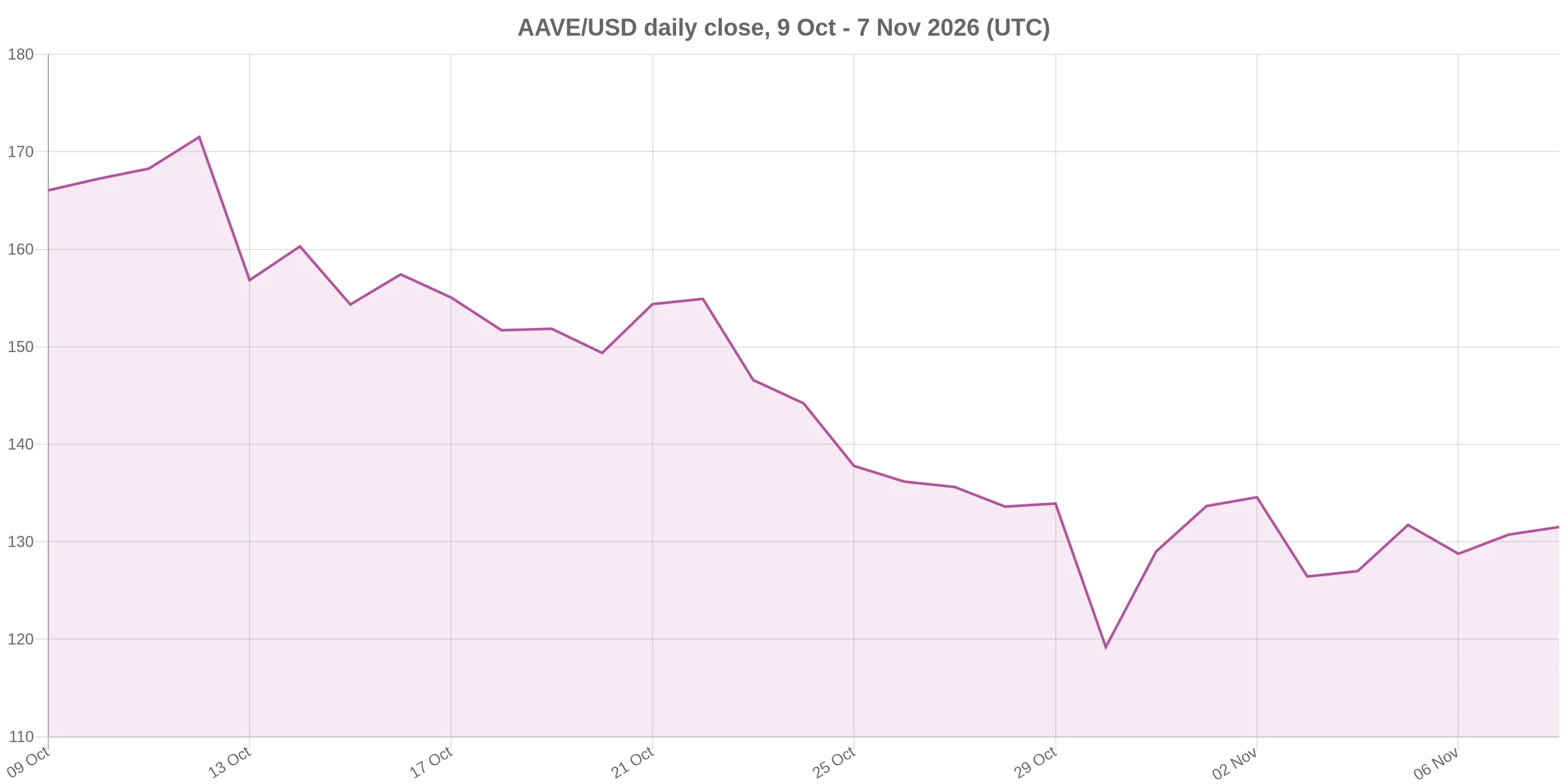
The price record around the announcement is quiet. AAVE closed at $166.05 on 9 October and $131.52 on 7 November, a decline of 20.8% across 30 days, having traded between $119.20 and $171.52 with an average close of $144.51. It was up 0.91% over 24 hours and 0.35% over seven days at the time of the snapshot, and $130.74 at 00:00 UTC on 7 November against $131.51 nine hours later. A move that small cannot be attributed to a corporate transaction announced after European markets closed on 6 November; the available evidence does not establish that the deal moved the token in either direction.
What Aave’s Lending Stack Looked Like Before Avon
Aave Labs already runs four products with different users. Aave App is a savings app, Aave Pro is the advanced lending interface, Aave Kit lets fintechs offer savings and loans to their own customers, and Aave Horizon is an institutional venue for borrowing stablecoins against tokenised real-world assets. The Avon team’s brief, per the announcement, is to help build new capabilities such as fixed-rate lending across the network and product layers, which means the work could land in any of them.
The base layer is Aave V4, which is live on Ethereum and carries the risk-isolation and liquidity architecture any new market type would have to fit. Risk isolation is not a theoretical concern for this protocol. On 30 October, BlockchainReporter reported that Aave froze its V3 and V4 markets after the Binance exploiter deposited $60 million in USDT and borrowed 19,762 WETH, a reminder that a single counterparty can force a protocol-wide response.
Institutions have been the other front. In September, Aave put forward custodied collateral lending for institutions, a structure in which collateral sits with a custodian rather than in a user wallet. A fixed-rate term market is the logical companion to that work: an institution that can post custodied collateral still needs to know its funding cost for the life of the loan, which a floating rate does not provide.
The disclosure is also thin on the business side. The post names no revenue, no user base, no licence and no integration cost, which is consistent with buying capability rather than buying a running business. That is a different kind of transaction from an acqui-hire at a distressed startup, and a different kind of risk: Aave Labs is paying now for a product that does not exist yet, and the return depends on whether a term market attracts lenders willing to lock capital inside a protocol.
Questions the Announcement Leaves Open
Four things are missing from the post, and each one changes how the deal should be read.
The first is price. Without a consideration figure, there is no way to judge whether Aave Labs paid for a team, a codebase or an option on a product category, and no way to compare the deal with the protocol’s own treasury spending.
The second is governance. Aave Labs is a core contributor to the network, not the network itself. The announcement does not describe a DAO proposal, an ARFC, or a vote, and it does not say whether fixed-rate markets would need their own risk parameters, caps or steward review. Whether a Labs-built product of this kind ships inside the DAO-governed protocol or alongside it is left open, and the answer determines who bears the risk if a term market misprices duration.
The third is what happens to Avon’s existing work. The post lists technology, domains and related assets. It does not mention any licence, regulated entity, live deployment or user base, and it does not say whether Avon’s markets will be migrated, merged into V4 or retired.
The fourth is timing. There is no engineering milestone, no testnet, no audit and no launch window in the text, which is consistent with an acquisition of capability rather than a delivery announcement.
Frequently Asked Questions
Did Aave Labs acquire Avon?
Yes. Aave Labs announced on 6 November 2026 that it had acquired the team and technology behind Avon, a group that built fixed-rate and floating-rate lending markets and an onchain order book. The announcement did not disclose the purchase price.
Who joined Aave Labs in the deal?
Three people are named. Avon founder Prince Sinha and Ayush Kaul join the Aave Labs engineering team, and Omar el-Ashaal joins the business development team. The post says the group will keep developing the Avon technology inside the Aave ecosystem.
Can Aave users take a fixed-rate loan now?
No. The announcement describes fixed-rate lending as a capability Aave Labs is building with the Avon team. It names no chain, collateral, maturity, audit or launch date, and Aave’s existing markets continue to price loans on the utilisation curve of each reserve.
Why is fixed-rate lending difficult onchain?
A floating rate is produced automatically by a utilisation curve. A fixed rate requires a lender and a borrower to agree a price for a defined term, which needs an order book for rate discovery, a way to transfer the lender’s position before maturity, and a liquidation framework that works when the coupon no longer adjusts with utilisation.
Does AAVE represent a claim on Aave’s deposits?
No. AAVE is a governance token used to vote on changes to the network and its treasury through the Aave DAO. The $33 billion of deposits belongs to the users who supplied it and is repayable to them, so comparing deposits with the token’s $2.03 billion market capitalisation compares two separate balance sheets.
What would confirm the deal is producing a product?
A verifiable step rather than a headline: a governance proposal setting out fixed-rate market parameters, a documented deployment on a named chain, or an audit publication covering a term-lending module. None of those appear in the 6 November announcement.
Data: CoinGecko, snapshot 7 November 2026, 09:50 UTC.
This story was originally published by Blockchain Reporter. Read the original article.