TON Strategy Generates $13.1M in Staking Revenue as Telegram Launches Native Wallet
TL;DR:
- TON Strategy Company reported $13.1 million in quarterly revenue generated primarily from GRAM staking rewards as of September 30, 2026.
- The company’s treasury accumulated 235.1 million GRAM tokens at the close of the third quarter, maintaining 232.9 million active units in validation.
- Telegram initiated the rollout of its native wallet in the ecosystem, backed by smart contract technical upgrades on The Open Network.
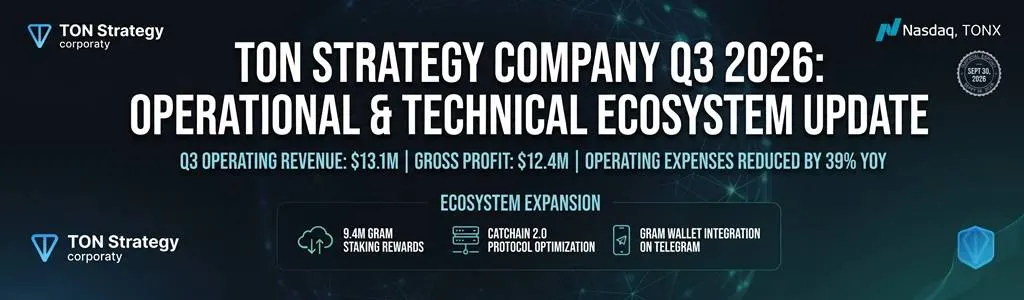
The financial results of TON Strategy Company (Nasdaq: TONX) for Q3 2026 were presented on Tuesday, November 10. According to official information, the company’s revenue from treasury and validation activities rose to $13.1 million.
This figure represents a sequential moderation compared to the $15.0 million reported during Q2 2026. The firm’s official financial report reveals that revenues stemmed primarily from staking rewards liquidated at the fair market value of the GRAM asset at the time of acquisition. Management explained in the document that the sequential decline in revenue was due to the lower average market price of the token in the secondary market throughout the period.
In terms of operating performance, the firm generated a gross profit of $12.4 million, equivalent to 95% of its total gross revenue. Consolidated operating expenses dropped to $8.4 million compared to $13.8 million in the previous quarter, marking a 39% reduction. According to the earnings report, this decrease reflected lower advisory fees, reduced personnel costs, and the closure of liabilities linked to prior business, lifting the operating income from continuing activities to $4.0 million.
However, the company declared a pre-tax net loss from continuing operations of $22.9 million for the period. Documentation submitted to regulators indicates that this negative balance was driven by a $27.2 million unrealized loss in the fair value of its digital asset reserves, in direct contrast to the $82.8 million gain recorded in the second quarter of 2026.
Ecosystem Expansion and Technical Rollout on Telegram
As of September 30, 2026, the entity custodying a digital asset balance with an approximate market value of $348.5 million, down from $369.5 million reported at the close of June. The corporate treasury totaled 235.1 million GRAM tokens, of which 232.9 million remain locked in validation nodes within The Open Network.
During the analyzed quarter, accumulated rewards reached 9.4 million GRAM. The company recorded an annualized gross staking yield of 16%. According to statements attributed to TON Strategy CEO Kevin Wilson, the return remained favored by improvements in validation fees applied to the protocol following the implementation of the Catchain 2.0 technical upgrade earlier in the year.
The report detailed that the corporate balance sheet closed with $25.3 million in cash and cash equivalents, maintaining a structure free of financial debt. During this same three-month interval, the company allocated $5.7 million to repurchase 1.8 million shares of common stock in the stock market.
On the network’s operational front, The Open Network validators backed two configuration technical upgrades aimed at boosting transaction processing. The Config 30 configuration was designed with the purpose of increasing transactions-per-second performance by up to 30% to mitigate congestion in view of higher user concurrency.
Concurrently, Telegram began the controlled distribution of its integrated native wallet, named Gram Wallet. The integration leverages a smart contract architecture governed by the protocol. According to technical specifications presented by the network, this scheme allows messaging platform developers to add direct storage and interface optimizations without requiring users to transfer their funds to different addresses.
Network node operators confirmed that the deployment process for the new integration tools will continue gradually over the coming weeks, subject to consensus parameter stability verification among validators
This story was originally published by Crypto Economy. Read the original article.