South Korea Weighs 99% Cold Wallet Rule After Binance Hack
TL;DR
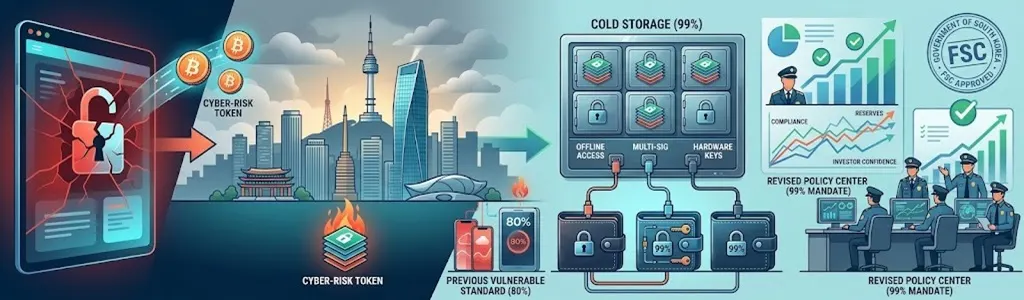
- South Korea is considering increasing the minimum cold wallet storage requirement for crypto exchanges from 80% to approximately 99%.
- The Financial Services Commission is reviewing stricter custody standards following a reported $6.3 billion Binance-related security incident.
- The proposal could strengthen investor protection while encouraging exchanges to improve asset segregation, custody infrastructure, and operational security.
South Korea is reviewing stronger cryptocurrency custody standards after a major security breach at Binance exposed vulnerabilities in centralized exchange infrastructure. Financial authorities are pushing domestic platforms to increase offline asset storage, with a potential 99% threshold drawing attention across the digital asset industry.
The Financial Services Commission (FSC) has urged local exchanges to strengthen their cold wallet reserves, improve withdrawal controls and reinforce cybersecurity procedures. The discussion comes as South Korea seeks to protect investors without undermining the operational efficiency of its cryptocurrency market.
South Korea Reviews Stricter Cold Wallet Requirements
Under the country’s Virtual Asset User Protection Act, cryptocurrency exchanges must already keep at least 80% of customer digital assets in cold wallets. These wallets remain disconnected from the internet, reducing exposure to remote attacks compared with hot wallets, which facilitate regular deposits and withdrawals.
However, the latest regulatory discussions could significantly raise that standard. A 99% requirement would leave exchanges with considerably less flexibility to maintain immediately accessible online reserves, making liquidity management an important consideration for trading platforms.
Financial Supervisory Service data cited by South Korean media shows that domestic exchanges already operate with different cold storage levels. At the end of September, Upbit held 99.17% of customer assets offline, while Bithumb reported 94.76% and Coinone reached 85%.
Digital X, formerly known as Korbit, recorded 82.79%, while GOPAX stood at 80.54%. These figures suggest that a stricter threshold would affect exchanges differently, with some already operating close to the proposed level.
Binance Hack Raises Broader Security Questions
The regulatory review follows the October 29 Binance security incident, which involved approximately $6.34 billion in digital assets. Binance said it would cover the financial impact and reported that it had frozen or intercepted approximately $2.85 billion. The FBI attributed the attack to North Korean hackers, according to the exchange’s published investigation update.
The incident also exposed risks beyond wallet storage. Reports indicate that attackers compromised devices used by software engineers before exploiting internal systems and accessing wallet infrastructure. This highlights why offline reserves alone cannot eliminate security threats.
South Korea’s FSC has therefore also called for continuous transaction monitoring, stronger administrator permissions, additional incident-response personnel and improved withdrawal approval procedures. Exchanges were also encouraged to maintain additional financial reserves.
This story was originally published by Crypto Economy. Read the original article.