Shiba Inu Exchange Reserves Drop to 85 Trillion SHIB as Price Faces Selling Pressure

What to Know
- Shiba Inu exchange reserves declined to 85.84 trillion tokens, reflecting reduced trading platform holdings despite persistent market selling pressure.
- Exchange net flows reached a positive 10.94 billion SHIB, indicating incoming transfers still exceed withdrawals despite the broader weekly reserve decline.
- SHIB trades near $0.00000463, facing resistance around $0.00000500 while weakening technical indicators expose prices to further potential declines across markets.
Shiba Inu (SHIB) exchange reserves have declined to approximately 85.84 trillion tokens, reducing the cryptocurrency’s available supply across trading platforms. The decline comes as SHIB struggles with persistent selling pressure, keeping its price below several important technical levels.
According to recent on-chain data, exchanges currently hold 85.8432 trillion SHIB, representing a marginal 0.01% increase over 24 hours. Meanwhile, the seven-day reserve trend shows substantial withdrawals, indicating that investors have transferred significant holdings away from exchanges.
Shiba Inu Exchange Holdings Decline Despite Positive Daily Netflows
The reduction in exchange reserves has changed Shiba Inu’s supply distribution, with fewer tokens remaining immediately available for trading. Investors typically transfer cryptocurrencies into private wallets for storage, reducing the balances held across centralized trading platforms.
Significantly, the remaining exchange reserves carry an estimated value of $397.45 million, reflecting a 1.69% decline within 24 hours. This valuation reflects both the quantity of tokens held and changes in SHIB’s market price.
Despite the weekly reserve decline, exchange net flow remains positive at approximately 10.94 billion SHIB, indicating that incoming transfers exceed outgoing transactions. This development suggests that some investors are still moving tokens onto exchanges despite the broader withdrawal trend.
Additionally, the difference between weekly reserves and daily net flows highlights mixed investor activity across different periods. While exchange holdings have decreased over seven days, recent inflows indicate that selling pressure remains present.
The lower reserve balance could reduce immediate selling supply, particularly if investors maintain their holdings outside centralized exchanges. Nevertheless, the latest netflow figures show that the reduction has not eliminated potential selling activity.
SHIB Price Falls Below Key Support as Bearish Pressure Persists
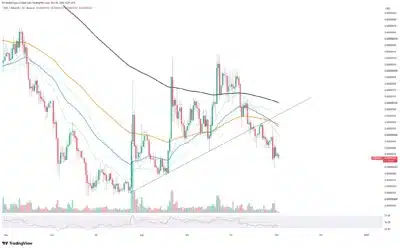
Shiba Inu’s market performance remains weak despite the reduction in exchange-held tokens, with technical indicators showing persistent bearish conditions. TradingView’s daily SHIB/USDT chart places the cryptocurrency near $0.00000463 following a breakdown below its ascending support trendline.
Furthermore, SHIB trades beneath several important moving averages, reflecting sustained weakness across its broader price structure. The breakdown has also increased the importance of nearby support levels as sellers maintain control of market momentum.
Source: TradingView
Immediate resistance stands between $0.00000500 and $0.00000530, creating a potential recovery barrier for buyers attempting to reverse recent losses. Meanwhile, the $0.00000440 to $0.00000450 region represents the next significant support area if selling pressure increases.
A recovery above the resistance range would strengthen SHIB’s technical position, particularly alongside further reductions in exchange reserves. Conversely, sustained trading below these levels would leave the cryptocurrency exposed to additional downward pressure.
Conclusion
Shiba Inu’s decline to approximately 85.84 trillion exchange-held tokens signals reduced available supply despite persistent bearish market conditions. Meanwhile, positive daily net flows and weak technical indicators show that selling pressure remains a significant challenge for SHIB.
This story was originally published by 36Crypto. Read the original article.