Blumenthal Gives Binance and Tether Until Jan. 4 to Produce Records

Richard Blumenthal’s letters went out on Nov. 5 with a 60-day clock attached. Binance, Tether, World Liberty Financial and Fight Fight Fight LLC have until Jan. 4, 2027 to give the Senate Permanent Subcommittee on Investigations the records it has been asking for, or the panel says it will consider other ways of getting them.
One date lands sooner. The letter to Binance chief executive Richard Teng asks the exchange to confirm receipt with subcommittee staff by Nov. 9, and to start producing documents by Nov. 30.
Blumenthal signed that letter as ranking member. His office described him in the release announcing the batch as the subcommittee’s incoming chair. That is the detail that changes the arithmetic: from January he runs the panel instead of sitting as its senior minority member, and a request that could be ignored becomes one a chairman can escalate.
What the four crypto letters ask for
The Nov. 5 batch was wider than crypto. Letters also went to Homeland Security Secretary Markwayne Mullin, FCC Chair Brendan Carr and donors to the White House ballroom project, according to the release. The four crypto recipients each sit on a separate thread of the same inquiry.
- Binance. The letter to Teng renews requests first made on Feb. 24, 2026 and again on Apr. 1, 2026 and says the exchange has produced no responsive records in 18 months. First production is due Nov. 30, with later tranches on a schedule agreed with staff. The letter carries the earlier correspondence as an attachment, so the subcommittee’s questions are on the record in one file.
- Tether. The release ties the stablecoin issuer to a Sept. 28 subcommittee report that describes Tether and its dollar token as “a significant financial lifeline within Iran’s shadow banking network.” The Tether letter is dated the same day and carries the same deadline.
- World Liberty Financial. Blumenthal opened an inquiry into the Trump family’s crypto ventures in May 2025, and in July 2026 held a public forum that published testimony from $TRUMP buyers who said they lost thousands of dollars.
- Fight Fight Fight LLC. The company behind the $TRUMP memecoin received its own letter on the same terms.
Every letter carries the same warning, quoted in the release: “Please also note that failure to voluntarily produce the requested records and information by January 4, 2027, will leave the Subcommittee with no choice but to consider alternative measures to obtain compliance.”
Eighteen months, four requests, no records
The Binance letter is the most specific about what has and has not happened, and it is unusually blunt for a document that will be read by the recipient’s lawyers.
“For 18 months, the Permanent Subcommittee on Investigations (‘the Subcommittee’) minority has been conducting an inquiry into the illicit use of cryptocurrencies, including Binance’s anti-money laundering policies and practices,” it opens. Then: “Throughout this period, despite repeated requests, you have failed to adequately respond to the Subcommittee’s requests and have not produced any responsive records.”
The paper trail behind that sentence runs to four requests and one hearing-style forum:
- Feb. 24, 2026. First records request, with five numbered items and a March 6 deadline, focused on two Binance counterparties, Hexa Whale and Blessed Trust, and on the dismissal of compliance staff who investigated them.
- March 2026. Binance published a formal response and then a second compliance post disputing the reporting behind the inquiry.
- Apr. 1, 2026. Blumenthal renewed the demand with seven numbered requests and an Apr. 14 deadline, writing that Binance “may have provided misrepresentations or misleading information to the Subcommittee and to the public.”
- Sept. 28, 2026. The subcommittee minority published its report on Tether, USDT and Iran’s shadow banking network.
- Nov. 5, 2026. Four letters, one deadline of Jan. 4, 2027, and a Nov. 30 start date for Binance.
Two numbers in the correspondence frame the dispute better than the prose does. The first is 18 months, the length of the inquiry. The second is 60 days, the window the new letters actually give.
The $110,000 figure at the center of the argument
The sharpest exchange in the file concerns how much business Binance did with Iran.
“Binance claimed that only $110,000 was directly exchanged with four major Iranian crypto exchanges last year, when based on reports, hundreds of millions of dollars have been transferred to Iran-linked entities,” the Apr. 1 letter states.
Request three of that letter asks Binance to break out year-over-year flows with each of six named exchanges: Nobitex, Wallex.ir, Excoino, Bitpin, Aban Tether and Bit24. It also asks for the methodology, and specifically for amounts to include transfers to wallets that were only later linked to an Iranian exchange.
The letter lists delays that read as the committee’s real grievance. Binance took two months to answer law enforcement requests about terrorist financing by Hexa Whale and another two months to remove the shell entity involved, it says. Removing Blessed Trust as a vendor took at least five months after warnings.
Set the two headline figures beside each other and the gap is roughly four orders of magnitude: $110,000 is 0.0055% of the “nearly two billion dollars” that the Feb. 24 letter says flowed to sanctioned entities before the transfers were caught. That comparison is not like for like. Binance’s number covers direct trades with four named exchanges; the larger figure covers reported flows to sanctioned entities through intermediary accounts. The scope, not the arithmetic, is the argument, and scoping is exactly what request three tries to pin down.
The letter also quotes a label that Binance investigators allegedly applied to some accounts: “Don’t block. Internal accounts.”
Why Jan. 4 is the date that matters
Jan. 4, 2027 is 60 days after the letters and 56 days from today. It is also one day after the date the 20th Amendment sets for a new Congress to convene, Jan. 3, which in 2027 falls on a Sunday. Lawmakers can set a different convening day by law, so the gap between the two dates can narrow or widen; either way, the deadline falls on or after the first day a new Congress can be seated.
What “alternative measures” means is not spelled out. A ranking member cannot issue a subpoena on his own authority; a committee chairman can move the panel toward one, and enforcement of a Senate subpoena runs through the full chamber and, ultimately, the courts. The letters promise escalation without describing it, which is standard practice for a document meant to be produced in a negotiation.
The ratio worth keeping in view is 18 months against 60 days. The subcommittee spent a year and a half asking. It has now given the exchange two months, with a hard date on the other side.
The stablecoin totals behind the Tether letter
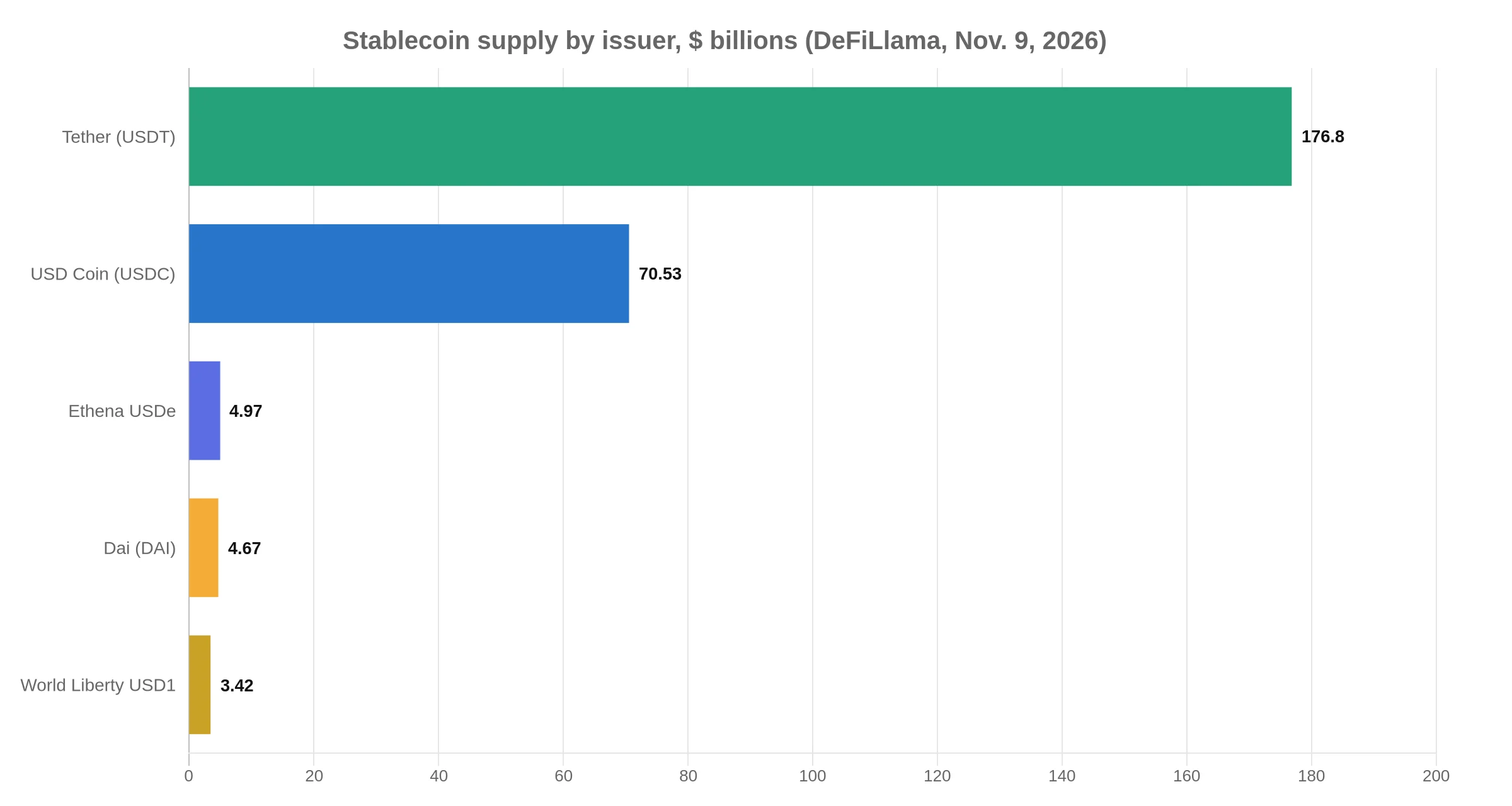
The Tether thread has a numeric backdrop that the letters do not spell out. Tether’s USDT had $176.80 billion in circulation on Nov. 9, or 59.97% of the $294.80 billion across all stablecoins tracked by DeFiLlama. USD Coin held $70.53 billion, or 23.9%.
World Liberty Financial’s USD1, the token issued by another of the four recipients, carried $3.42 billion, about 1.16% of the total. Two of the four letters in the batch therefore went to stablecoin issuers, and the largest of them controls roughly three-fifths of the dollar-token market that the Sept. 28 report examined.
The report’s finding, in the subcommittee minority’s own words, is that Tether and its dollar token “have become a significant financial lifeline within Iran’s shadow banking network.” That is a characterization by one party’s staff, not a court finding, and it is the specific claim the Nov. 5 letter asks the company to answer with records.
What the letters do not establish
No subpoena appears in the file. No court has found that Binance or Tether broke sanctions law. The underlying reporting the letters rely on comes from Fortune and the New York Times, cited in the footnotes, and the Senate document is a demand for evidence rather than a verdict on it.
Binance’s public position has been consistent since March: that it cooperates with law enforcement, that the exposure figures in press reports are overstated, and that its compliance program is stronger than critics allow. The exchange made that case in its March filings and again when Blumenthal first raised the allegations, a response this newsroom covered at the time in Binance Slams Blumenthal’s Accusations, Stresses Top Compliance Measures.
The committee’s language is careful in the same way. It says Blumenthal is “concerned” that Binance “may have provided misrepresentations,” not that it did. It says records “have not been produced,” not that they were destroyed. Those distinctions matter if the matter ever reaches a court or a formal Senate enforcement vote.
What to watch next
Four dates carry the story from here. Nov. 9 is the receipt confirmation for Binance. Nov. 30 is the first production date. December is when staff would negotiate the follow-on schedule. Jan. 4, 2027 is the deadline that converts a request into a decision about coercion.
Two things would change the picture before then: a public production by any of the four recipients, or a committee vote on compulsory process. Neither has happened. In the meantime, the enforcement backdrop keeps moving independently of the letters. On Nov. 7, the Treasury’s OFAC branch sanctioned eight Canadian money services businesses accused of swapping Iranian rials for crypto, a reminder that the Iran flows at the center of the Senate inquiry sit inside a wider enforcement push that does not wait for congressional document production, as we reported in OFAC Sanctions Eight Canadian Money Services Firms That Swapped Rials for Crypto.
The practical question for readers who hold USDT or USD1 is narrower than the politics. Neither letter changes how either token trades or redeems today. What they change is the paper trail: after Jan. 4, the subcommittee either has documents it can publish or a public record of a company that declined to provide them.
Data: DeFiLlama.
This article is not intended as financial advice. Educational purposes only.
This story was originally published by Blockchain Reporter. Read the original article.