API3 Overhauls Its Token, Governance and Mission: A Fixed 200,000,000 Supply and a New Direction in AI
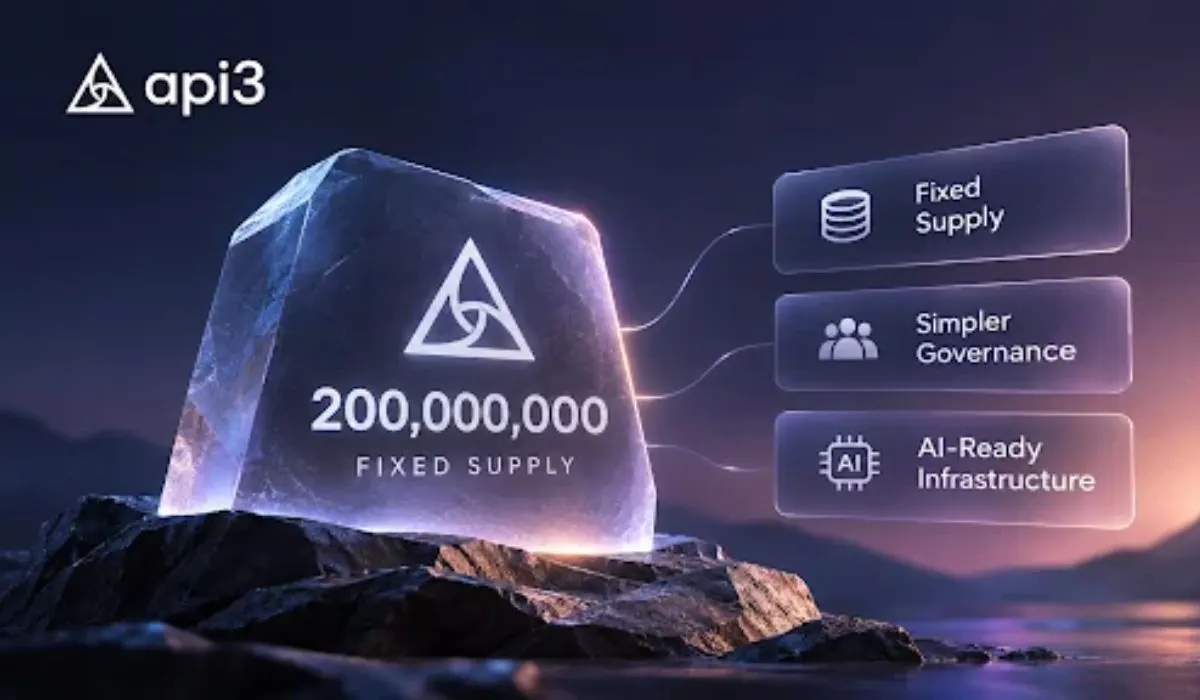
In a single proposal executed on 4 November, API3 permanently capped supply, ended emissions, moved to one-token-one-vote governance, and removed its own ability to mint tokens, while pointing its signed-data infrastructure at the fast-growing economy of AI agents.
API3, a provider of first-party data infrastructure, has executed a proposal that resets the protocol on three fronts at once: its token, its governance, and its mission. The proposal permanently capped API3’s supply at 200,000,000, ended five years of token emissions, moved governance to a simpler one-token-one-vote model, and removed the protocol’s ability to ever mint new tokens. Together, the changes clear the ground for a sharper focus on bringing signed, verifiable data to decentralized finance and to AI agents.
A FIXED SUPPLY OF 200,000,000
Since 2021, API3’s staking pool has minted about 90.1 million tokens, roughly 47% of today’s supply, at a pace near 950,000 a week, or close to 26% a year. The proposal minted API3 one final time to reach exactly 200,000,000, removed every minter, and transferred ownership of the token contract to a dead address that no one controls. No new API3 can ever be created, and the token’s maximum supply, listed until then as effectively unlimited, is fixed and final.
SIMPLER GOVERNANCE, A SMALLER ATTACK SURFACE
Governance moves from the framework API3 built in 2021 to a streamlined model on Snapshot. Each API3 token counts as one vote, whether it is staked or simply held, and the DAO’s multisignature wallets execute what passes. Retiring the old contracts and ending the token’s mintability also closes a specific risk: a hostile vote reaching the mintable token contract and printing new supply.
Hostile votes have drained treasuries across DeFi, and an unlimited mint was the bigger prize. With no minter to capture and no owner to compromise, that path is removed. The change comes as the cost of finding smart-contract exploits falls sharply, making old, rarely touched code a standing target.
WHERE API3 IS HEADING
With its foundations settled, API3 is concentrating on where its five years of API and DeFi experience applies next. Its curation business runs on-chain lending markets on the price feeds it builds across Ethereum, Base and Robinhood Chain, backing them with its own treasury capital alongside outside depositors, a structure it calls skin in the game.
AirnodeHub, now live in early access at airnodehub.api3.org, extends API3’s provider-signed model to the wider API market, letting AI agents discover, verify, and pay original providers for signed data. As agents become a growing share of internet traffic and begin paying for data per call, API3 is positioning AirnodeHub as the place that work is sourced and paid for.
A DEFLATIONARY DESIGN FUNDED BY REVENUE
Revenue from API3’s live operations, its curation business and the activity behind it, already buys API3 on the open market every month. AirnodeHub does not yet earn revenue; once per-request payments go live, it is designed to add to those buybacks as well. With emissions ended and supply fixed, the token is built to be deflationary over time: a capped asset with recurring, revenue-funded buy-side demand in place of a steady flow of newly minted tokens.
ABOUT API3
API3 builds data infrastructure that delivers signed, real-world data directly from the providers that produce it. It runs first-party data feeds across DeFi, curates on-chain lending markets on those feeds, and is extending its provider-signed model to the wider API market through AirnodeHub. API3 is governed by its token holders through the API3 DAO, with a fixed supply of 200,000,000. The project’s broader work and the marketplace itself can be explored at api3.org and airnodehub.api3.org.
This story was originally published by ZyCrypto. Read the original article.